Fulbright Scholarship 2026: The Complete Guide for International Students Applying to Study in the United States

Every year, thousands of strong applicants lose weeks of preparation time on one avoidable mistake with the Fulbright Foreign Student Program: they go straight to the American website, start filling out the wrong form, and only discover months later that Fulbright does not work the way almost every other scholarship on this site works. You do not apply to Washington. You apply through the Fulbright Commission or the U.S. Embassy in your own country, and the deadline, the required documents, and even the interview format are set locally, not centrally. Get that one fact wrong and you can miss your window entirely, sometimes by half a year.
This guide walks through how the Fulbright Foreign Student Program works in 2026, what it funds, who administers it, the eligibility rules that apply almost everywhere, and the specific things that separate a shortlisted application from one that never makes it past the first screening. It is written for the roughly 4,000 people worldwide who will receive this award for the coming academic year, and for the far larger number who should be applying but are not, usually because they assumed it was out of reach or because they never found the right entry point.
Fulbright has a reputation problem it does not entirely deserve. Because it is the most recognizable name in international academic exchange, a lot of applicants assume the acceptance bar is impossibly high and quietly rule themselves out before ever reading the actual eligibility criteria. In reality, the program funds close to 4,000 people a year across more than 160 countries, spanning fields from public health to fine art to agricultural economics, and a meaningful share of grantees each cycle are first time applicants with solid but unremarkable academic records who simply built a specific, well researched proposal and matched it to what their local Fulbright office was looking for.
What the Fulbright Foreign Student Program Covers
Fulbright is the flagship international exchange program of the United States government, created in 1946 under legislation from Senator J. William Fulbright. The Foreign Student Program is the branch of it built specifically for non-U.S. citizens who want to pursue a master's degree, a doctorate, or non-degree research at an American university. It operates in more than 160 countries and funds close to 4,000 new grantees every year, which makes it one of the largest fully funded international scholarship programs in existence, not a small boutique award reserved for a handful of exceptional candidates.
Approximately 4,000 grants awarded annually | 160+ participating countries | Tuition, travel, stipend, and health insurance covered | Administered by IIE and AMIDEAST | foreign.fulbrightonline.org
The program is funded by the U.S. Department of State's Bureau of Educational and Cultural Affairs and administered on the ground by the Institute of International Education, known as IIE, which handles most of the world's regions, and by AMIDEAST, which covers most of the Middle East and North Africa. A Fulbright grant generally covers tuition and required fees, a monthly living stipend, round trip international airfare, and health insurance for the length of the program, which is typically one to two years for a master's degree.
Why You Cannot Apply Directly Through the U.S. Website
The website foreign.fulbrightonline.org exists mainly as an information hub, not an application portal. Program eligibility, required test scores, application deadlines, and the interview process all vary by country because each Fulbright Commission or U.S. Embassy runs its own local competition before candidates are ever forwarded to the central Fulbright Foreign Scholarship Board for final approval. A candidate in Nigeria and a candidate in Vietnam are technically applying to the same global program, but the practical process each of them goes through can look quite different.
This is the single biggest source of confusion for first time applicants. You need to find the Fulbright Commission, binational foundation, or U.S. Embassy Public Affairs Section responsible for your country of citizenship or legal residence, and everything from there flows through that office. Deadlines are typically somewhere between February and October depending on the country, and country deadlines are frequently a full year ahead of the academic year the grant starts, since the review, nomination, and placement process takes many months.
Eligibility Requirements That Apply in Most Countries
While specific rules differ slightly by country, a consistent core set of requirements applies almost everywhere. You need to reside in your country of citizenship or legal residence at the time you apply. You need the equivalent of a completed U.S. bachelor's degree with a strong academic record by the time your program starts. English proficiency is required and is usually demonstrated through a recent TOEFL score, with a recommended minimum around 550 on the paper based test or 79 to 80 on the internet based test, or an IELTS score of roughly 6.5 or higher, though exact thresholds vary by country and by field.
Bachelor's degree or equivalent | TOEFL iBT 79 to 80 or IELTS 6.5 recommended | Resident in country of citizenship at application | Preference given to those without recent U.S. academic experience
Applicants who are already studying in the United States are generally ineligible to apply for the Foreign Student Program. Green card holders and U.S. permanent residents are not eligible either, since the whole point of the program is bringing new perspectives into the United States rather than funding people who already have a pathway there. Preference in most countries is given to candidates who have not already had significant recent academic experience in the U.S., since one of the program's core goals is genuine cross-cultural exchange rather than continuing an education someone has already started domestically.
IIE Placement Versus Self-Placement
Once you clear your country's local selection round and are nominated, you will typically go through one of two placement models depending on your country. Under IIE Placement, the Institute of International Education's placement team works on your behalf to find a suitable graduate program or research host, using the information from your application to approach universities directly, negotiate admission, and manage the offer process. You are not applying to individual universities yourself in this model. IIE is doing that work for you based on your stated field and goals.
Under Self-Placement, which is used in some other countries, you are responsible for applying directly to specific U.S. graduate programs yourself, much like a typical international graduate school application, while your Fulbright funding is confirmed separately. Which model applies to you depends entirely on your country's Fulbright Commission, so this is one of the first things to clarify when you start the process, because it changes how much of the university research and applications you personally need to handle versus how much is handled centrally.
The Realistic Timeline From Application to Departure
Fulbright is not a fast process, and applicants who assume they can start in January and be studying in the U.S. that same fall are almost always wrong. A typical cycle runs something like this: your country's application opens roughly a year to eighteen months before the intended program start date, national deadlines fall somewhere between February and October, shortlisted candidates are interviewed in person by a local selection committee usually a few months after the deadline, and final nominees are then reviewed by the Fulbright Foreign Scholarship Board in Washington before formal offers go out. Grants for a given academic year typically require departure the following August or September, meaning many candidates apply nearly two years before they arrive on a U.S. campus.
Recent examples make this concrete. The U.S. Embassy in Chad set a May 2025 deadline for candidates who would not begin studies until fall 2027. The program in Mozambique for the 2027 to 2028 cycle asked final year students to submit diplomas by August 2026 for a program starting a year later. If you are thinking about Fulbright, the right time to start researching your country's specific process is roughly eighteen months before you want to be on campus, not six months before.
What Makes an Application Competitive
Selection committees, both at the local level and at the Fulbright Foreign Scholarship Board, screen applications on three broad factors: the quality and feasibility of your proposed study or research plan, your academic and professional record, and how well your candidacy advances the program's core goal of mutual understanding between your country and the United States. That third factor is the one most applicants underweight. Fulbright is not simply funding academic merit. It is funding people it believes will build a genuine bridge between two countries, both during their time in the U.S. and afterward when they return home and apply what they learned.
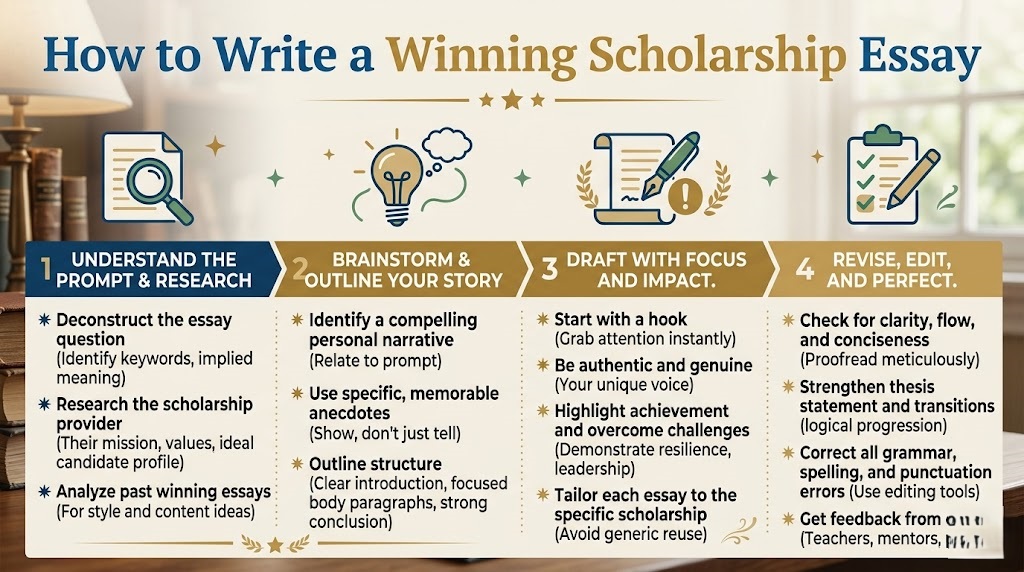
A strong Statement of Grant Purpose is specific rather than aspirational. It names the exact research question or course of study, explains why it requires being physically present in the United States rather than being pursued anywhere else, and connects clearly to what the applicant plans to do with that training afterward. Vague language about wanting to "gain international experience" or "become a global leader" reads as generic to a committee that reviews hundreds of similar statements every cycle. The applications that advance are the ones where a reader finishes the essay and can describe in one sentence exactly what this person wants to study and why it matters.
A Recent Policy Detail Every Applicant Should Know
Fields of Study and Regional Priorities
Fulbright accepts applications across virtually every academic discipline, including interdisciplinary fields, and does not favor one subject area globally. However, individual country programs sometimes flag priority fields tied to that country's specific development goals or the bilateral relationship with the United States. Mozambique's program, for example, has flagged priorities including artificial intelligence, cybersecurity, supply chain management, and public health, aligned with national development needs and current U.S. strategic priorities. Checking your specific country's award description for stated field priorities is worth the ten minutes it takes, since applying with a proposal that clearly connects to a stated national priority can strengthen your file without changing your actual research interests.
Common Mistakes That Sink Otherwise Strong Candidates
The most frequent error is assuming the process runs like a typical graduate school application, where you apply once and wait for one decision. Fulbright layers a national competition, a Washington level review, and often a separate university admission process on top of each other, and missing any one stage ends the process regardless of how strong you are on the others. The second most common mistake is submitting a Statement of Grant Purpose that could be sent to any country's Fulbright office with the country name swapped out. Committees read these constantly and screen them out fast. The third is underestimating how early to start. Financial documentation, academic transcripts, recommendation letters, and English test scores all take time to assemble properly, and a rushed application assembled in the final two weeks before a deadline rarely reflects the applicant's actual strength.
The last mistake worth naming directly is applying only once and giving up after a rejection. Fulbright explicitly allows previous unsuccessful applicants to reapply, and while recent grantees face a competitive disadvantage in some cycles, this does not apply to first time applicants who were simply not selected. If your proposal was strong but the fit or timing was not right, a revised application in a later cycle, informed by what you learned the first time, is a completely normal and often successful path.
The J-1 Visa and the Two-Year Home Residency Requirement
Fulbright grantees enter the United States on a J-1 exchange visitor visa, not the F-1 student visa most other international students use. This distinction matters more than it sounds like it should. Most J-1 exchange visitors, including nearly all Fulbright Foreign Student Program grantees, are subject to a two-year home country physical presence requirement once their program ends. In practice, this means that after you finish your degree, you are generally expected to return to your home country, or another country outside the United States, for a minimum of two years before you become eligible for certain other U.S. visa categories, including the H-1B work visa and permanent residency sponsorship.
This is not a punishment. It reflects the program's actual purpose, which is building capacity and mutual understanding by having grantees return home and apply what they learned, not funding a pathway to permanent U.S. immigration. Some grantees are able to apply for a waiver of this requirement under specific circumstances, but a waiver is the exception rather than something to plan around. If your long term goal is settling permanently in the United States, it is worth understanding this requirement clearly before you accept a Fulbright grant, since it will shape your options for several years after you finish.
Inside the Interview Stage
Most country programs include an in-person interview with a local selection committee, typically made up of Embassy representatives, U.S. and local scholars, and Fulbright alumni from your own country. This interview usually happens a few months after the written application deadline and is where a large share of candidates get eliminated, often candidates whose written applications looked strong on paper. The committee is testing whether the specificity in your Statement of Grant Purpose reflects genuine depth of thinking or whether it was polished language sitting on top of a shallow plan.
Expect direct, sometimes uncomfortable questions. Why this specific university and not five others that offer similar programs. What you will do if your first choice research supervisor is unavailable. How your project connects to a policy problem or gap you have personally observed, not one you read about. Committees are also listening for how you talk about returning home afterward, since a candidate who talks exclusively about opportunities in the United States without a credible account of what happens after the grant tends to read as a weaker fit for a program built around the idea of exchange rather than one-way departure.
Comparing Fulbright to Other Ways to Study in the United States
Fulbright is often the first program people think of when they think about funded study in the U.S., but it is not the only route, and it is not always the best fit depending on your field, your work experience, and your timeline. Fulbright tends to favor candidates with a clear research question or professional development goal and some demonstrated leadership or community engagement, rather than candidates straight out of undergraduate study with limited work history. If you are earlier in your career, university-specific funding, departmental assistantships, or country-specific government scholarships to the U.S. may in some cases be a more realistic starting point, with Fulbright as a later goal once you have more professional experience to draw on.
It is also worth knowing that Fulbright funds a relatively narrow slice of your total cost of living if you are used to programs that provide a very high stipend. The living allowance is calculated to be adequate but not generous, set at levels appropriate to modest graduate student living in your specific host city, not a comfortable professional salary. Candidates coming from countries where the cost of living is very different from a typical U.S. college town sometimes find the adjustment more significant than they expected, which is worth planning for financially before you accept a grant.
Budgeting for the Parts Fulbright Does Not Cover
Even with tuition, a monthly stipend, travel, and health insurance covered, most grantees still need some personal savings before departure. Initial setup costs such as a security deposit on housing, winter clothing if you are moving somewhere with a cold climate you have not experienced before, a laptop if yours is not reliable enough for graduate level work, and the first few weeks before your first stipend payment clears can add up to a meaningful amount. Many past grantees recommend budgeting the equivalent of at least one to two months of expected living costs as a buffer before you leave, since Fulbright's stipend, while adequate, is not designed to absorb large one-time setup costs on top of monthly living.
Health insurance is included, but grantees should read exactly what the provided policy covers before departure. It is designed to meet basic needs but is not always as complete as employer-sponsored insurance in your home country, and some grantees choose to supplement it, particularly if they have a pre-existing condition or specific ongoing medication needs that require confirmation the plan will cover.
Non-Degree Research and the Foreign Language Teaching Assistant Track
Most people associate Fulbright with a master's or doctoral degree, but the Foreign Student Program also funds two other tracks that get far less attention and are sometimes easier to be competitive for. The non-degree research track, sometimes called the Visiting Researcher category, funds nine to ten months of dedicated research at a U.S. university or institution without requiring enrollment in a full degree program. This suits candidates who are already enrolled in a doctoral program at home and need a period of specialized research access, lab facilities, or archival material only available in the United States, rather than a full second degree.
The Foreign Language Teaching Assistant Program, known as FLTA, is a separate category that places native or near-native speakers of a foreign language at U.S. universities to teach their language part time while taking academic courses themselves. It is specifically aimed at early career language educators and typically has a shorter, more defined program length than the full degree track. Candidates interested in an academic career in language education, translation, or international communication sometimes overlook FLTA entirely because they assume Fulbright only funds full graduate degrees, when in fact this track can be a strong standalone opportunity or a stepping stone toward a full Fulbright grant in a later cycle.
Where to Start
Your very first step should not be drafting an essay. It should be finding the Fulbright Commission, binational foundation, or U.S. Embassy responsible for your country and reading their specific country page in full, since it will tell you the deadline, the required test scores, the placement model, and any field priorities that apply to you specifically. From there, the general information at foreign.fulbrightonline.org is a useful reference for understanding how the wider program works, but your actual application, your actual deadline, and your actual decision all run through your home country office.
If Fulbright's timeline or competitiveness feels daunting, it is worth applying alongside other fully funded programs in the same cycle rather than treating it as your only option. Our guide to fully funded scholarships open in 2026 covers several programs with different selection criteria and timelines, and our breakdown of how to write a winning scholarship essay applies directly to strengthening your Fulbright Statement of Grant Purpose as well.