How to Write a Winning Scholarship Essay: 7 Templates That Work
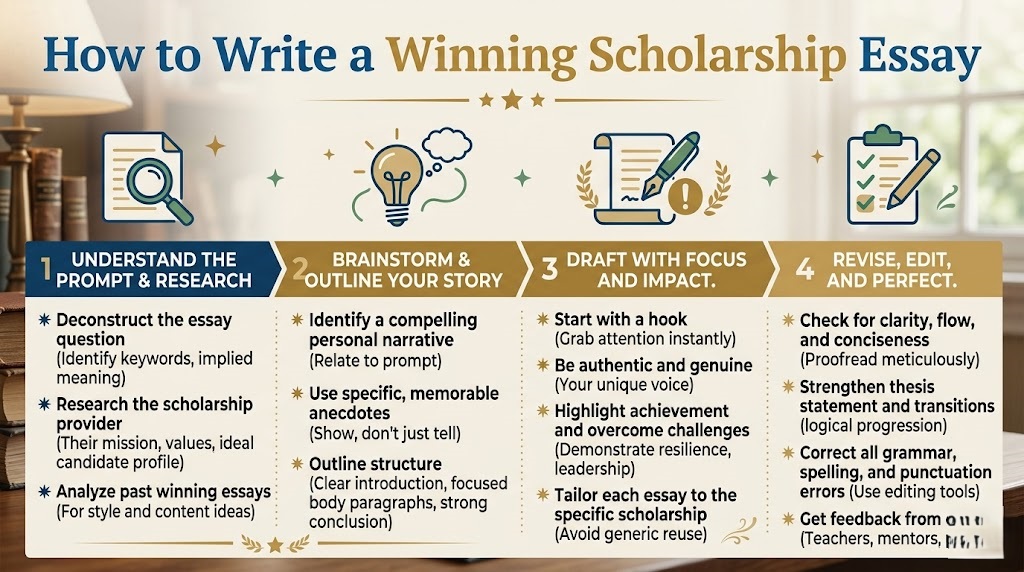
Scholarship essays are not about showing off. That assumption (that more impressive equals better) is one of the most common reasons strong candidates write weak applications. What selection committees are doing when they read essays is looking for specificity, credibility, and fit. A former Chevening selection panelist sorting through forty applications in a mock review session will set aside a generic essay about wanting to contribute to national development within thirty seconds, regardless of the applicant's credentials. The essays that make the shortlist are the ones that give the reader something specific enough to remember. This guide shows exactly what that looks like in practice.
The Research You Must Do Before Writing Anything
Before you write a single word, answer four questions about each program you are targeting. First, what is the stated mission of this scholarship? Read the selection criteria document, not the homepage marketing copy. Second, what does a successful applicant profile look like? Look for past winner profiles if the program publishes them. Read alumni testimonials. Some programs post cohort data. Third, what does this scholarship require you to commit to? Return requirements, alumni network engagement, specific career trajectories. Fourth, and most honestly: is my profile aligned with what they are selecting for, or am I trying to perform an alignment that does not really exist?
This research takes two to three hours per program minimum. It is not optional. The applicants who win the most competitive scholarships almost universally describe doing extensive program research before writing anything. The applicants who get rejected usually describe discovering the program two weeks before the deadline and writing quickly. Those two groups produce essays that read completely differently, and selection panels notice the difference within the first three sentences.
Template 1: The Problem-Solution Arc
Best for: Chevening, Commonwealth, Mastercard Foundation, World Bank JJ/WBGSP, and any scholarship with a strong development or social impact mandate
This template opens with a specific, concrete problem you have witnessed or been involved in addressing through your professional work. Not "poverty is a major challenge in my country." Something observable, specific, and directly connected to your actual work experience. A gap in rural healthcare infrastructure you identified through three years of field work. A policy implementation failure you documented with data. A technology access barrier that is limiting educational outcomes in a specific region where you have direct experience.
From that concrete problem, you identify a gap in your own knowledge or skills that has prevented you from addressing it more effectively. This gap must be genuine and specific. "I lack the evaluation frameworks to assess whether the programs I design are working" is a real, specific gap. "I want to learn more about development" is not a gap. Then you explain how the specific degree or program you are applying for fills that gap directly. Not universities in general. Not the country in general. This specific program, these specific courses or research opportunities, this particular faculty expertise.
The final section describes what you will do when you return. This needs to be concrete beyond any doubt. Not "I will contribute to my country's development." That phrase should be retired from scholarship essays permanently. What specific role are you returning to? What specific initiative will you advance? What specific outcome will be measurably different because of this degree? The committee is trying to visualize where their investment is going. Give them a clear picture.
The most common failure mode for this template: making the problem too large for the proposed solution. If your essay describes a national or continental-scale problem and your post-degree plan is a single policy recommendation, the committee sees a credibility gap. Scale the problem description to match your actual sphere of influence. A smaller, more specific problem addressed with a convincing and well-evidenced post-study plan is far more persuasive than a massive problem paired with a vague resolution.
Template 2: The Turning Point Narrative
Best for: DAAD, Gates Cambridge, Knight-Hennessy, and academic merit programs where intellectual development and research trajectory matter
This template opens with a single moment that changed your intellectual direction. Not your entire academic life story. One moment. A paper you read that reframed a question you had been circling for years. A research project where you hit the limit of your existing knowledge and felt the gap sharply. A field experience that made a theoretical problem viscerally real in a way that reading about it never did.
From that moment, you trace a clear and coherent path to your current application. What research have you done since that turning point? What questions did that work raise that you could not answer with your current tools or training? What preliminary findings have you developed? What does this specific program offer that lets you pursue those questions at a level you cannot reach without it? The connection between the turning point and the specific program should feel logically inevitable, not constructed for the application.
The failure mode here: over-dramatizing the turning point. Not every intellectual pivot needs to involve a crisis or a tragedy. Some of the most compelling academic essays describe a quiet realization rather than a dramatic event. Reviewers have read hundreds of crisis narratives. A precisely described intellectual curiosity, specific enough to be clearly genuine, stands out in a stack of dramatic stories. It also signals that the applicant is driven by actual ideas rather than primarily by the desire to study abroad.
Template 3: The Credentials-Plus-Gap Structure
Best for: Fulbright, Australia Awards, Humphrey Fellowship, and professional development programs where work experience is a primary selection criterion
This template opens with what you have accomplished professionally, presented not as a CV recitation but as a narrative of what you have built, what you have learned from building it, and what you have discovered you cannot do effectively despite your experience. The gap you identify needs to be genuine and specific. "I can design community health programs but I lack the quantitative evaluation frameworks to know whether they are working as intended" is a real gap. "I want to learn more about my field" is not useful as a gap statement.
From there, you explain how this specific degree addresses that gap in practical terms. Not just the degree program in general, but specific courses, faculty research, institutional partnerships, or methodological approaches that directly give you the skills you have identified as missing. Reviewers can immediately tell when you have read beyond the program homepage versus when you have copied and slightly rephrased a paragraph from the admissions brochure. The applicants who get shortlisted describe what they found when they read the actual syllabi, faculty profiles, and recent graduate outcomes.
Close this template with a post-degree plan that is a natural, credible extension of your existing work rather than a dramatic pivot. Both Australia Awards and Fulbright are specifically suspicious of applicants who appear to want a funded degree primarily to change career direction entirely. They are investing in people who will deepen and strengthen what they are already doing, not fund career pivots for people who have lost interest in their current trajectory.
Template 4: The Comparative Context Lens
Best for: Erasmus Mundus, Oxford, Cambridge, and programs where studying in a specific country or academic tradition is substantively relevant to your research
This template works specifically when the location of your proposed study is itself academically meaningful to your work, not just geographically appealing or personally exciting. It opens by establishing a substantive comparison: how your home academic or professional context differs from the host context in ways that are directly relevant to the questions you are investigating or the skills you need to develop.
I have seen this done effectively by a public health researcher arguing that studying universal healthcare system design in Sweden would give her a structural comparison point that was necessary for the hybrid systems design work she was doing in East Africa. She was not going abroad to learn in general. She was using the specific academic environment as a research instrument that her work required. That framing makes the location choice feel intellectually inevitable rather than aspirationally chosen.
The failure mode: treating the comparison as primarily cultural rather than academic or professional. "I want to experience different perspectives and bring them home" is not a Comparative Context essay. It is a gap year application statement. The comparison must be grounded in specific intellectual or professional questions where the host context provides something the home context cannot.
Template 5: The Leadership Trajectory
Essential for: Chevening, YALI, Mandela Washington Fellowship, and any program that explicitly lists demonstrated leadership as a primary selection criterion
This is the template most Chevening applications attempt and most get wrong. The failure mode is listing things you have done that could be called leadership without analyzing what you learned from doing them. The committee has read that version thousands of times. What works is a tighter, more analytical structure: here is a specific situation I was trying to change, here is the specific challenge that required me to coordinate or influence others, here is what I learned about how change happens in complex environments that I did not understand before going through that experience.
The post-study section of a Leadership Trajectory essay needs to be proportionally concrete. Not "I plan to return and contribute to my country's development." That sentence needs to be permanently retired. What specific role are you returning to? What specific initiative will your degree enable? What specific outcome will be different? The best answers describe a concrete action with a realistic timeline, connected credibly to your existing role, that is plausible to someone who understands the actual professional field you are describing.
One structural note specific to Chevening: the networking essay is separate from the leadership essay and asks something different. The networking question is about your ability to build and maintain professional relationships across sectors. Keep the two answers complementary but distinct. Conflating them into one theme across both essays is a common pattern that weakens both responses.
Template 6: The Research Proposal Hybrid
For: DAAD research grants, PhD scholarship applications, and programs requiring a research statement alongside a personal motivation essay
Many PhD and research-track applications require something that sits between a personal statement and a full research proposal. The hybrid is harder to write than either because it needs to establish your credibility as a developing researcher while also connecting your research agenda to a personal trajectory that makes the committee care about your specific question.
Start with the research question itself. Not your life story and not a broad description of your field. The specific question you are trying to answer, stated precisely enough that a non-expert can understand what you are trying to figure out and why it matters. Then work backward from that question: how did you arrive at it through previous work, what have you already done to investigate it, what preliminary findings do you have, and why is this specific program and this specific supervisor the right environment to pursue the answer properly.
One action that almost nobody takes but that makes a real difference: email your potential supervisor before you submit your application. Not to ask whether you should apply, but to have a substantive intellectual exchange about your research direction. A supervisor who has already engaged with your work, even briefly by email, reads your application differently from a completely cold submission. Most PhD applications are reviewed by potential supervisors before reaching any central scholarship committee. A prior relationship, even a short email exchange, is a meaningful structural advantage.
Template 7: The Return Commitment Essay
Best suited to: Chevening, MEXT, Australia Awards, GKS, CSC, and any government-funded scholarship with an explicit post-study return requirement
For programs with return requirements, the post-study plan is not a final paragraph. It is the structural center of the entire essay. The committee needs to believe you have a realistic, specific plan for what you will do when you return, not just a stated intention to contribute positively to your home country in unspecified ways.
The technique that works best: build the essay backward from the return. Open by describing concretely and specifically what you are returning to. What role, what organization, what initiative, what responsibility? Then work forward from there: what gap in your current knowledge or tools is preventing you from doing that work more effectively? Why can you not close that gap locally? Why does this specific program in this specific country provide exactly what you need? The forward motion of the essay is a backward justification for the return commitment, and that structure makes the return feel inevitable rather than obligatory.
The signals that undermine credibility even when return intentions are genuine: "I hope to eventually return" instead of "I will return to my current position at." Describing your plans in the host country in more detail and more enthusiasm than your home country plans. Being specific about what you will experience and learn abroad while being vague about what you will do with it at home. Selection committees read these signals reliably. If your return plan is real, make it the most specific and most detailed section of your essay, not an afterthought.
Practical Rules That Matter
Word limits are hard limits, not guidelines to approach approximately. Submitting 1,050 words for a 1,000-word limit signals that you either cannot edit or you do not respect the program's requirements. Both interpretations damage your application. When you are over the limit, cut entire arguments that are not doing load-bearing work for your central claim. Do not trim sentences to shave words. Ask what each paragraph is accomplishing and remove the ones that are not accomplishing enough.
Read your essay aloud before submitting it. Every single time. Awkward sentence constructions that look fine on screen become immediately obvious when you hear them. Long sentences that meander through multiple ideas are much easier to catch aurally than visually. This takes about ten minutes for a typical scholarship essay and consistently produces better final drafts. It is also one of the least commonly practiced revision techniques despite being one of the most consistently effective.
Ask someone who does not work in your field to read your final draft. If they can summarize in one sentence what you want to do and why this scholarship helps you do it, your essay is clear. If they cannot give you that summary, revise until they can. The reviewers reading your application at the end of a long evaluation session are not going to work hard to extract your central argument. Give it to them directly.
Write your first draft without editing as you go. The weakest scholarship essays are often the ones that were edited too early in the process. They are technically polished but intellectually thin because the writer was trying to sound good rather than say something. Draft messily, get everything out, then edit with the question: what is this essay arguing and is every sentence advancing that argument? Leave yourself at least 48 hours between completing a draft and doing your final review. You will always find something important on that last read that you missed before.
For the programs to target with these templates, see our full guide at fully funded scholarships 2026. For programs accessible without IELTS, see masters scholarships without IELTS in 2026.
Building the Calendar Before You Write Anything
Applicants who do well across several competitive scholarships in one cycle almost always share one habit, and it is not writing talent. They built a calendar before they drafted a word.
The reason is arithmetic. A serious application needs a personal statement, a study plan, two or three referees, certified transcripts, a language certificate, and in several cases a proposal. Referees need a month. Universities take two to six weeks to issue official transcripts. Language tests need to be booked, sat, and reported. None of that compresses, and the deadlines cluster.
A workable schedule for a cycle with January deadlines looks roughly like this:
- June and July: choose three to five programmes that fit your profile honestly. Read each one's selection criteria and eligibility rules in full, not the summary on an aggregator site.
- August: approach referees with a specific request and a one-page summary of what you are applying for. Book any language test now, because slots in high-demand cities disappear.
- September: draft the core statement with no programme-specific framing. Who you are, what you are trying to do, and the gap between where you are and what that requires.
- October: request official transcripts and any certified translations. Begin adapting the core statement to each programme's actual question.
- November: first full drafts of every application. Send them to readers.
- December: revise, chase referees who have not submitted, and check every document against each programme's format rules.
- January: submit several days early. Portals fail under load on deadline day, and they do it every year.
The single most useful line in that schedule is the one about drafting a core statement with no programme-specific framing. It forces you to work out what you are saying before you start bending it toward what you think a particular committee wants to hear, and the bending is much easier once the substance exists.
The Editing Pass That Does the Most Work
First drafts of scholarship essays are almost always too long, too general, and too keen to impress. The revision that fixes this is mechanical rather than creative, which makes it learnable.
Go through the draft sentence by sentence and ask one question of each: is this sentence carrying weight? A sentence earns its place if it supplies evidence, advances the argument, or tells the reader something they could not have guessed. Sentences that restate the previous sentence in different words, announce what you are about to say, or describe your enthusiasm do none of these. Cut them.
Then hunt adjectives. "I have a deep passion for improving healthcare outcomes in rural communities" asserts a feeling. "I spent fourteen months running a mobile clinic that saw 3,000 patients across six villages" demonstrates one, and the reader draws the conclusion themselves. Every claim about your character should be replaced by the fact that produced it, wherever such a fact exists.
Check your opening against a simple test: could the first two sentences appear at the top of anyone else's essay? Openings that begin with a definition, a dictionary quotation, a statistic about the size of a global problem, or a childhood memory of wanting to help people are so common that committees read past them automatically. Start with something only you could have written.
Finally, read the whole thing aloud. Sentences you cannot say without running out of breath are too long, and phrases that embarrass you to hear are the ones to delete.
Getting Feedback Without Losing Your Own Voice
Feedback improves essays and can also flatten them, and the difference lies in how you ask.
Ask specific questions rather than "what do you think." Useful questions: Where did you stop believing me? What is the one thing you remember an hour later? Which paragraph could be removed without loss? Where did you have to reread a sentence? Each of these produces something actionable; the general question produces line edits and politeness.
Choose readers for different purposes. Someone in your field checks whether the technical content is credible. Someone entirely outside it tells you where the jargon has crept in, which matters because selection panels frequently include people who are not specialists in your area. Someone who knows you well tells you whether it sounds like you.
When you receive contradictory advice, and you will, the deciding vote belongs to the selection criteria rather than to the most confident reader. Go back to what the programme says it is looking for and keep whichever version serves it.
Be careful with the one form of help that damages applications: heavy rewriting by someone else. Essays that have been professionally polished read as smooth and hollow, and experienced readers notice the mismatch between a flawless statement and an interview candidate who speaks differently. Keep the imperfections that are yours. A slightly awkward sentence in your own voice is worth more to a committee than an elegant one in nobody's.
For programme-specific requirements and the essays each committee is reading for, see our guides to fully funded scholarships in 2026 and scholarships for African students. If your essay gets you shortlisted, the next stage is covered in scholarship interview questions and how to answer them.