High-Paying Skills to Learn in 2026: AI, Data Science, and Cybersecurity Careers Explained
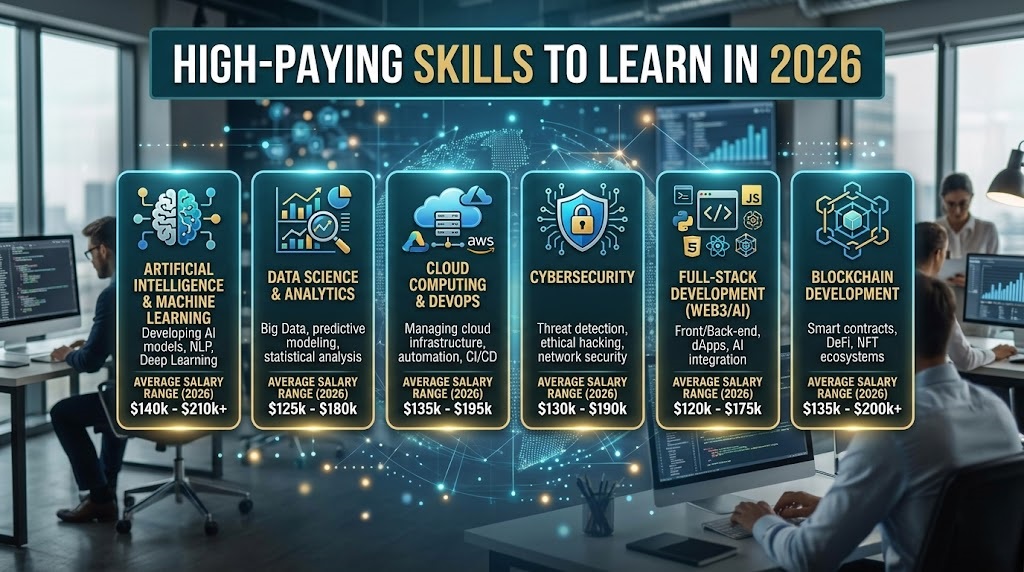
Most "high-paying skills" content is misleading in a specific way: it lists skills that pay well at the senior level, leaves out the two to four years it takes to reach that level, and presents the destination as if it were the starting point. This guide does something different. For each skill covered here, the focus is on the realistic learning path from zero to job-ready, the honest timeline, the actual entry-level salary rather than the headline senior figure, and the specific tools and platforms that lead there. The skills are real. The salaries are real. The timelines are also real, and they are longer than most guides admit.
AI and Machine Learning Engineering
Entry salary: $90,000–$130,000 | Senior salary: $170,000–$350,000+
AI and machine learning roles are the highest-compensating technical positions in the market in 2026. The skills that lead to these roles: Python (mandatory), mathematics (linear algebra, calculus, statistics - not optional), machine learning frameworks (PyTorch, TensorFlow, Hugging Face), data engineering (SQL, cloud data pipelines), and increasingly, large language model fine-tuning and deployment. The honest timeline to a first ML engineering job: two to three years of focused study and project work if starting from zero, one to two years if you have a math or CS background. The fastest path is a combination of Andrew Ng's deeplearning.ai specializations on Coursera, building a GitHub portfolio of real projects, and contributing to open-source ML repos. deeplearning.ai is still the clearest on-ramp.
AI Prompt Engineering and LLM Integration
Salary range: $80,000–$160,000. This is the more accessible AI path for people without strong mathematics backgrounds. Prompt engineers design the inputs, workflows, and evaluation systems for AI-powered products. LLM integration developers connect language model APIs into applications. The technical bar is lower than ML engineering but rising - companies increasingly want people who can write code alongside their prompt work. Python, API integration, and a deep practical understanding of how LLMs behave are the core skills. Anthropic, OpenAI, and Google all publish free documentation that is the best available training material.
Cybersecurity
Entry salary: $65,000–$95,000 | Senior: $130,000–$220,000+
Cybersecurity has a structural talent shortage that shows no sign of resolving. Demand is growing faster than education pipelines can fill it. The paths into cybersecurity range from technical (penetration testing, threat intelligence, security engineering) to more accessible (security operations center analyst, compliance and risk management, security awareness training). The certifications that carry weight with employers in 2026: CompTIA Security+, Certified Ethical Hacker (CEH), CISSP for senior roles, and increasingly, cloud security certifications from AWS, Azure, or Google Cloud. TryHackMe and HackTheBox are the most effective practical learning platforms for beginners. The timeline to a first SOC analyst role from zero: six to twelve months with dedicated daily practice.
Data Science and Analytics
Entry salary: $70,000–$100,000 | Senior: $130,000–$200,000
Data science in 2026 has bifurcated. True ML/AI-adjacent data science requires significant statistical depth and is effectively ML engineering-lite. Business-facing analytics - sometimes called data analytics or BI - is more accessible and has enormous demand. Tools: SQL is non-negotiable for either path. Python (pandas, scikit-learn) for data science. Power BI, Tableau, or Looker for analytics. The fastest path to a first data analytics job: Google's Data Analytics Certificate on Coursera (approximately six months), plus SQL practice on Mode's SQL tutorial and Kaggle competitions to build portfolio projects.
Cloud Architecture and DevOps
Entry salary: $80,000–$120,000 | Senior: $150,000–$250,000
Cloud architects and DevOps engineers design, build, and maintain the infrastructure that modern software runs on. AWS, Azure, and Google Cloud between them control most of the global cloud market. The cloud certifications that most reliably result in job interviews: AWS Solutions Architect Associate (most widely recognized), Google Cloud Professional Cloud Architect (fastest growing), Microsoft Azure Administrator (dominant in enterprise contexts). Each certification takes two to four months of preparation. The salary jump from having none to having one significant cloud cert is often $20,000–$30,000 at the entry level.
The Skill Most Lists Leave Out: Technical Communication
Here's the thing that separates high earners from mid-level earners in every technical field: the ability to explain what you do to people who don't do what you do. The data scientist who can present findings to a business audience commands a premium over an equally skilled one who can't. The security engineer who can write a board-level risk memo earns more than one who produces technically perfect reports that executives can't parse. Communication is a skill. It's learnable. And in 2026, with AI handling more of the baseline technical work, the humans who communicate, contextualize, and make decisions about that work are increasingly the ones getting paid the most.
What Makes a Skill Pay Well in the First Place
Lists of high-paying skills go stale quickly because they describe the symptom rather than the cause. Three conditions determine whether something commands a premium, and a skill that has all three will pay well regardless of whether it appears on anybody's list.
Supply is short relative to demand. This is the obvious one and the least durable. Bootcamps and course platforms respond to any visible premium within about eighteen months, which is why the returns on a skill are highest for people who acquire it early and unremarkable for people who arrive after the wave.
The work sits close to money. Roles that visibly increase revenue or visibly reduce cost are paid from a different mental budget than roles that support the people doing so. This is why a mediocre enterprise salesperson often out-earns an excellent internal analyst. It is not fair and it is extremely consistent.
Failure is expensive. Where a mistake costs millions, leaks customer data, or halts production, employers pay for reliability rather than competence. Security, payments infrastructure, clinical systems, and regulatory work all price this way. The premium is insurance.
The skills that stay valuable for a decade tend to score on the second and third conditions rather than the first. Scarcity alone erodes. Proximity to revenue and consequence of failure do not.
One practical consequence: pairing a mid-tier technical skill with a domain where mistakes are costly usually pays better than chasing the single hottest technology. A competent data engineer in healthcare or finance earns more than a strong one in a low-stakes sector, for the same technical work.
Sales Engineering and Solutions Architecture
One of the best-paid roles that almost nobody sets out to enter. A sales engineer sits between the product and the customer's technical team, running demonstrations, designing integrations, and answering the questions a salesperson cannot.
Compensation is high because the role hits two of the three conditions at once: it is directly attached to closing revenue, and the supply of people who are both technically credible and comfortable in front of a room is small. Base salaries in the US commonly run $130,000 to $190,000 with a commission component on top; European equivalents sit around €75,000 to €120,000 with variable pay.
The entry route is unusual in that it rarely starts here. Most sales engineers are former developers, systems administrators, or implementation consultants who discovered they liked the customer-facing half of the job. If you are technical and have ever been pulled into a client call because nobody else could explain the product, this is a path already open to you.
What it demands is tolerance for a quota. The role carries revenue targets, and people who want purely technical work without commercial pressure tend to dislike it regardless of the pay.
Product Management, and the Version of It That Pays
Product management is widely recommended and unevenly compensated, because the title covers two different jobs.
The version that pays poorly is coordination: running the backlog, writing tickets, chasing status, translating between departments. It is necessary work, it is not scarce, and salaries reflect that.
The version that pays well owns an outcome. The product manager who decides what gets built, is accountable for whether it worked, and can defend the decision with evidence is operating a level above coordination, and compensation separates sharply at that line. Senior product roles at established technology companies commonly reach $150,000 to $220,000 in the US and €90,000 to €140,000 in major European markets.
The skill underneath is judgement under incomplete information, which is difficult to teach and reasonably easy to demonstrate. People who move into it successfully usually come from engineering, design, analytics, or a deep understanding of the customer, and they bring evidence of having made calls rather than having relayed them.
Technical product management (API products, developer tools, infrastructure, machine learning platforms) pays a further premium, because the pool of candidates who can hold a credible conversation with both a customer and a staff engineer is small.
Financial Planning, Analysis, and the Quiet Premium in Finance
Outside investment banking, which everyone knows pays well and costs your evenings, several finance functions pay unusually well for ordinary working hours.
Financial planning and analysis at a growing company is the clearest example. The work is forecasting, scenario modelling, and telling executives what the numbers imply rather than what they say. Senior FP&A roles reach $120,000 to $170,000 in the US and £65,000 to £100,000 in the UK, and the function is chronically understaffed because most accountants prefer reporting on the past to being wrong about the future.
Revenue operations is a newer and similarly underserved function, sitting between sales, marketing, and finance, and owning the data that connects them. It pays comparably and has a shorter entry path, since much of it is learned on the job.
Treasury and financial risk at any organisation holding significant cash in multiple currencies is a narrow specialism with very few practitioners and correspondingly firm pricing.
The common thread is that all three involve being accountable for a number that someone senior will act on. Qualifications help (a CFA, ACCA, or CIMA opens doors) but the differentiator is whether you can explain a forecast to a non-financial executive without either patronising them or losing them.
Privacy, Compliance, and Regulatory Specialisms
Regulation has expanded faster than the supply of people who understand it, and the resulting shortage is one of the most reliable in the professional market.
Data protection is the largest slice. GDPR, the growing patchwork of US state privacy laws, and equivalent regimes across Brazil, India, South Africa, and Nigeria have made privacy a standing function rather than a legal afterthought. Data protection officers and privacy programme managers earn $110,000 to $160,000 in the US and £60,000 to £95,000 in the UK, and demand is steady rather than cyclical.
AI governance is the newest version of the same pattern. The EU AI Act and comparable frameworks elsewhere require organisations to document, assess, and monitor automated systems, and almost nobody currently knows how to do this well. People combining a compliance background with genuine technical literacy about machine learning are scarce enough that the roles are frequently unfilled for months.
Financial crime and sanctions compliance, medical device regulatory affairs, and clinical quality assurance follow the same logic in their own sectors: mandatory, consequential, and staffed by a small pool.
The entry route rarely requires a law degree. Many practitioners move across from audit, operations, or a technical role in the regulated domain, add a certification such as CIPP/E or CAMS, and are hired on the combination.
Healthcare Data and Clinical Informatics
Healthcare pays a premium for technical skill because the sector is simultaneously data-rich, heavily regulated, and short of people who understand both the clinical and the technical side.
Clinical informatics (designing and running the systems that clinicians use, mapping data standards, making electronic records produce something usable) sits at that intersection. Salaries in the US commonly run $110,000 to $165,000, and the NHS and European health systems pay well above their usual technical bands for the same reason.
Health economics and outcomes research, real-world evidence analysis, and pharmacovigilance data roles all follow a similar pattern. Each requires understanding what the data represents clinically, not only how to manipulate it, and that requirement keeps the candidate pool small.
The route in is more open than it appears. Clinicians who learn SQL and Python are extremely employable. So are data professionals who spend a year learning the vocabulary, the standards such as HL7 and FHIR, and the regulatory constraints. Either direction works; the combination is what is scarce.
The Skills That Raise the Price of Everything Else
A handful of capabilities are not jobs in themselves but multiply the value of whatever else you do. They are consistently underweighted because they are hard to put on a certificate.
Writing clearly. In distributed organisations, decisions are made in documents. The person whose proposal is understood is the person whose proposal wins, and this compounds across a career more than any single technical skill.
Running a meeting that produces a decision. Rarer than it should be, immediately visible to senior people, and one of the fastest ways to be handed more scope.
Estimating. Being approximately right about how long something will take, and saying so before it starts, is the trait that separates people who are trusted with projects from people who are given tasks.
Reading a contract or a budget. Most technical professionals cannot, which means they cannot evaluate their own commercial position or spot the clause that will cause trouble in month eight.
A second language, used professionally. Worth a genuine premium in specific corridors: Spanish across the Americas, French across West and Central Africa, German in engineering and manufacturing, Arabic in Gulf infrastructure and development work.
What Each of These Costs to Acquire
Time and money vary widely, and the honest ranges are worth knowing before committing.
- Cloud and DevOps certification path: six to twelve months part-time, $300 to $900 in exam fees. The lowest-cost credible entry on this list, and the one with the most free learning material.
- Data analysis to employable standard: nine to eighteen months part-time. SQL, one scripting language, one visualisation tool, and three portfolio projects on real data. Cost can be near zero.
- Security, from a technical starting point: twelve to twenty-four months. Certifications matter more here than in most fields; expect $400 to $1,500 across the sequence, and considerably more for a CISSP once you have the required experience.
- Privacy and compliance: six to twelve months alongside an existing role. A CIPP/E costs around $550 plus membership, and is one of the better returns available on a single credential.
- Product management: not a course. One to three years of demonstrable ownership, usually acquired by taking on product-shaped work inside a job you already have.
- Sales engineering: no formal path. A lateral move from a technical role, typically six months of deliberately joining customer calls before applying.
- FP&A and finance: two to four years if pursuing a full professional qualification; under a year if moving across from accounting or operations with strong modelling skills.
Two patterns are worth noting in that list. The cheapest paths are the technical ones with mature certification ecosystems. The highest-paying ones mostly cannot be bought at all, because they are acquired by doing consequential work rather than by completing a syllabus.
Skills Losing Value, and What That Means for You
An honest list has to include the other direction, because time spent on a declining skill is the most expensive mistake available.
General-purpose content production has fallen sharply. Writing that summarises publicly available information, basic copywriting, and routine translation have all been compressed by automation. What has held value is writing that requires original reporting, subject expertise, legal accountability, or a named author the reader trusts.
Entry-level graphic production has moved the same way. Template work, simple asset resizing, and basic photo editing no longer support a career. Design that involves research, systems thinking, or accountability for a business outcome is unaffected.
Routine bookkeeping, basic manual testing, first-line technical support, and simple data entry are all contracting for the same reason: they are rule-following tasks with clear inputs and outputs.
The pattern is consistent enough to be useful as a filter. Work defined by following a known procedure is compressing. Work defined by deciding which procedure applies, being accountable for the outcome, or handling the situation the procedure did not anticipate is not.
If your current role sits in the first category, the response is neither panic nor denial. It is to move one step toward judgement within the same field, which is almost always a shorter distance than starting over somewhere new. For the longer arc of that transition, see our guide on building a six-figure remote career from scratch.