Remote Jobs That Pay $5,000/Month in 2026: No Degree Required

Six months of remote job applications with zero callbacks almost always traces back to the same set of problems, and they are rarely about qualifications. The CV is not written for international remote hiring managers. The cover letter does not address the specific credibility questions that come with hiring someone in a different country and time zone. The platforms being used are the wrong ones for the roles being targeted. A recruiter who works in remote hiring can identify these problems immediately. This guide covers them systematically, starting with the most common and most fixable.
How Remote Hiring Works Differently in 2026
Remote companies hire differently from office-based companies in ways that sharply affect how you should approach your application. First, the hiring pool is global. You are not competing against fifty applicants in your city. You are competing against potentially thousands of applicants from dozens of countries. To compete at the 5,000 dollar per month tier, your skills and portfolio need to be demonstrably strong enough to justify the investment relative to alternatives.
Second, the technical assessment happens before or during the interview, not after. At most remote-first companies, if you are applying for a design role they want to see your portfolio before they schedule a call. If you are applying for a writing role they may ask for a short sample. If you are applying for a development role there will be a technical challenge. Prepare for these assessments as seriously as you prepare for the interview itself, because for many remote companies the assessment is the primary filter and the interview confirms culture fit afterward.
Third, written communication is the primary signal of professional competence in remote hiring. Your application email, the way you describe your experience in writing, your responses during an async interview, all of these carry more weight than they would in an in-person context where personality and presence can compensate for weak written communication. Write clearly, specifically, and without unnecessary jargon. Every piece of written communication you submit during a remote job application is an audition for how you will communicate in the actual role.
Digital Marketing Specialist and Growth Marketer
Salary range: 4,000 to 8,000 dollars per month | Skills: SEO, paid media, analytics, email marketing | No degree required
Digital marketing is one of the clearest paths to 5,000 dollars per month in remote income for someone without a degree, because the hiring criteria are almost entirely output-based. Either your campaigns generate the results they were supposed to generate or they do not. Companies that hire remote digital marketers primarily look at three things: a track record of measurable results expressed in specific numbers, relevant platform certifications that signal baseline competence, and a portfolio or case studies of past work.
Google Digital Garage, HubSpot Academy, and Meta Blueprint all offer free certifications that carry genuine professional weight. The roles paying at the higher end of this range are typically growth marketer positions at SaaS companies or digital agencies where you are managing paid advertising budgets of 50,000 dollars per month or more and reporting directly on return on investment. Building to that level takes time. Many digital marketers start at 2,000 to 3,000 dollars per month, build a track record over 12 to 18 months, and reach 5,000 to 6,000 dollars per month in their second or third remote role. The progression is real and the ceiling is high.
Best platforms for finding these roles: We Work Remotely, Remote OK, LinkedIn with the remote filter applied, and direct outreach to companies whose marketing you admire. Direct outreach consistently outperforms competing in public job listings at the mid-to-senior level because you are not competing with hundreds of other applicants responding to the same post.
UX and UI Designer
Salary range: 5,000 to 10,000 dollars per month | Skills: Figma, user research, prototyping, design systems | No degree required
UX and UI design is one of the strongest degree-optional career paths in technology in 2026. The hiring criterion is entirely portfolio-driven. If your Figma work is strong, your case studies explain your design decisions clearly and analytically, and you can discuss your process coherently in an interview, the question of where you received your design training is secondary. Design portfolios are evaluated as outputs. Your education appears in your CV as a footnote if the work itself is good.
The self-taught path in design is well-established. Figma has its own free learning resources. Google's UX Design Certificate on Coursera costs approximately 200 dollars to complete and is recognized by hiring managers. The Interaction Design Foundation offers structured curricula for roughly 17 dollars per month. Building three to five strong case studies, each demonstrating a clear problem, your research and design process, the decisions you made and why, and the measurable outcome, is more valuable for getting your first role at 5,000 dollars per month than any certification alone.
Find design-specific remote jobs at Dribbble Jobs, Behance Job List, and We Work Remotely. The design community on LinkedIn is also an active source of direct job referrals, especially for mid-level and senior positions where hiring managers post before putting roles on public job boards.
Software Developer (Frontend, Backend, or Full Stack)
Salary range: 5,000 to 15,000 dollars per month | Skills: JavaScript, Python, or another core language plus frameworks | No degree required at many companies
Remote software development roles at the mid-level consistently pay between 5,000 and 15,000 dollars per month, and the degree requirement has loosened at most companies over the last five years. What matters is your GitHub profile, your ability to pass a technical assessment, and whether your code is clean, well-tested, and well-documented. Bootcamp graduates, self-taught developers, and computer science degree holders all compete in the same market, and the degree is rarely the deciding factor among candidates who can pass the technical screen.
Practical self-study paths: The Odin Project is free, well-structured, and teaches full-stack web development from fundamentals through advanced topics. freeCodeCamp covers HTML, CSS, JavaScript, and several frameworks with project-based learning at no cost. For more structured bootcamp-style paths, App Academy and Springboard offer programs with different cost structures. The critical output is a GitHub profile containing real, complete projects with readable code, not just a list of course completion certificates.
For international applicants targeting US and European companies specifically, Arc.dev and Toptal are the most effective platforms. Both vet developers and connect them directly with companies specifically looking to hire globally. The vetting process is rigorous, but clearing it puts you in front of companies that have already committed to international remote hiring, which removes a significant barrier that most job boards do not address.
AI Prompt Engineer and AI Content Trainer
Salary range: 4,000 to 8,000 dollars per month | Skills: Analytical writing, domain expertise, prompt design | No degree required
This is the newest high-paying remote category, and in 2026 it is also one of the most accessible for people without purely technical backgrounds. Companies building AI products need human experts to evaluate AI outputs, write training examples, compare model responses for quality, design effective prompts for specific professional use cases, and optimize workflows that incorporate language models. Scale AI, Appen, Telus International, and several other companies hire continuously for this work.
The higher-paying AI trainer roles, at 5,000 dollars per month and above, typically require strong analytical writing skills combined with real domain expertise in a specific professional field. If you have genuine expertise in medicine, law, finance, engineering, or education, that expertise combined with strong writing is exactly the combination that commands serious rates from companies building domain-specific AI systems. The work has a low barrier at the junior evaluation level and scales quickly with demonstrated quality and specialized knowledge.
One important distinction: there is a significant quality tier difference between the gig platforms paying a few dollars per hour for simple multiple-choice AI evaluations and the companies paying 4,000 to 8,000 per month for high-quality analytical content creation. The higher-paying positions involve a vetting process that reflects the difference. Look for roles listed on LinkedIn and company careers pages rather than general gig marketplaces when targeting the higher end of this range.
Content Strategist and Specialist Copywriter
Salary range: 4,000 to 8,000 dollars per month | Skills: Persuasive writing, SEO, industry knowledge | No degree required
Senior-level content strategy and specialist copywriting pay far more than most people expect, and a great deal more than the rates generalist freelance writers earn. The difference is specialization. A specialist copywriter who writes high-converting SaaS product pages, financial services regulatory content, or healthcare patient communications earns much more than a generalist who writes adequately on any topic. Specialization combined with strong writing is the combination that commands 5,000 dollars per month and above.
If you have real expertise in a specific industry, whether fintech, health and wellness, B2B software, e-commerce, legal services, or another professional sector, that expertise combined with strong writing skills is what companies in those sectors will pay serious money for. They are not buying words. They are buying your understanding of their audience, their regulatory environment, and their competitive picture. Build your portfolio at Contently, pitch directly to companies in your specialty, and apply to remote content roles on We Work Remotely and Remote OK filtered by your specialty area.
Sales Development Representative
Salary range: 4,000 to 7,000 dollars per month on-target earnings | Skills: Communication, CRM tools, resilience | No degree required
SDR roles involve outbound prospecting, cold outreach, and qualifying leads for senior salespeople. The base salary for most remote SDR positions is 40,000 to 55,000 dollars per year, but with commission the on-target earnings reach 50,000 to 70,000 dollars annually. No degree is required at the vast majority of companies because results are completely measurable. Either your outreach generates qualified pipeline or it does not.
Companies invest heavily in SDR training because the role is a pipeline into account executive careers that pay considerably more. If you have strong written and verbal communication skills in English, can maintain consistent performance through rejection, and are comfortable with CRM tools like Salesforce or HubSpot, this is a viable path to 5,000 dollars per month within six to twelve months. The role is inherently remote-first because outreach happens by phone, email, and video. Search for roles on RepVue, Betts Connect, and LinkedIn filtered by SDR and remote.
The Honest Timeline
Most people do not earn 5,000 dollars per month in their first remote role. The realistic progression for most people starting with limited relevant experience looks like this: six to twelve months building a skill with genuine depth, followed by three to six months building a portfolio and getting first projects at lower rates, followed by landing a first remote position that pays less than 5,000 dollars per month, followed by twelve to eighteen months of experience before positioning for the higher-paying tier. That is two to three years from zero to 5,000 dollars per month for most people.
This timeline is honest, not discouraging. The roles exist. The path is real. But anyone telling you it happens in three months is selling something. What you can do in three months is build a foundation that will matter in three years. Start now with that honest perspective and you will still be working toward it when many people who started with more enthusiasm but less honesty have already given up.
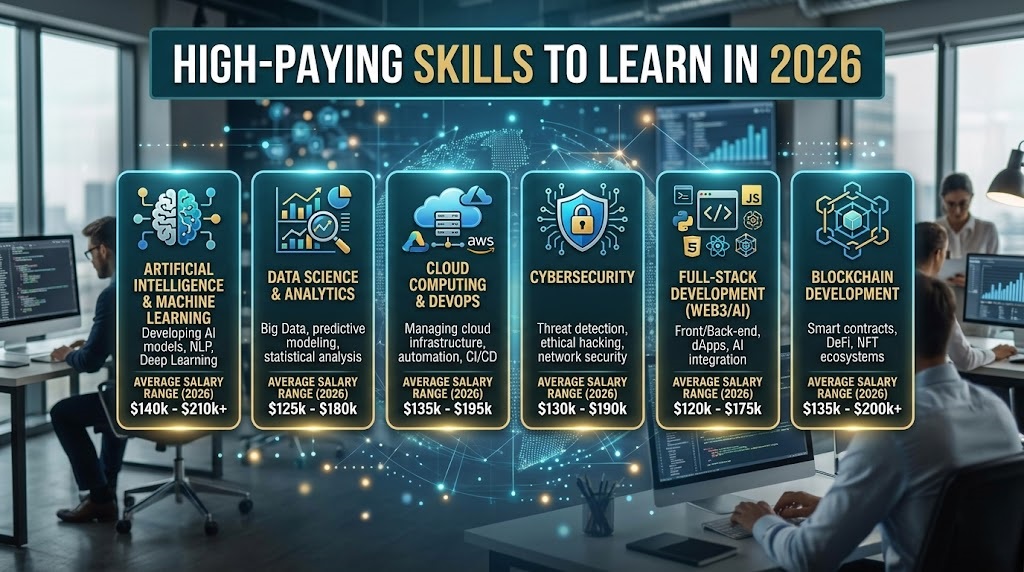
For the skill development side of this path, our article on high-paying skills to learn in 2026 covers AI, data science, cybersecurity, and development in detail. For the longer career arc, see our piece on from zero to 100K: how to land a six-figure remote career.
Where These Roles Are Advertised
General job boards are the worst place to look for remote work, because "remote" there usually means hybrid, or remote within one country, or remote until the policy changes. Filtering wastes most of the time people spend searching.
The boards built specifically for distributed hiring are a better starting point. We Work Remotely and Remote OK carry a high volume of developer, design, and marketing roles. Working Nomads and Remotive aggregate across sectors. Himalayas and Wellfound skew toward startups, which is where the willingness to hire internationally is highest. Dynamite Jobs and FlexJobs cover smaller operating businesses that rarely advertise elsewhere.
Two other channels produce better results than their traffic suggests. Company careers pages at businesses that were remote before 2020 (GitLab, Zapier, Automattic, Doist, Buffer and the hundreds of smaller firms that copied their handbooks) hire internationally as a matter of policy rather than exception. And the job channels inside professional communities, whether a Slack workspace for your specialism, a Discord for a particular toolchain, or a newsletter with a hiring section, carry roles that never reach a public board at all.
Read every posting for the fine print before applying. "Remote (US only)" and "Remote: must overlap 9am–1pm Pacific" and "Remote, EMEA time zones" are three completely different jobs. So is "remote-friendly," which in practice often means an office exists and the people in it get promoted.
Getting Paid When the Employer Is in Another Country
The mechanism by which money reaches you is not an administrative detail. It determines your tax position, your protections, and how much of the headline figure you keep.
Three arrangements are common. Direct employment through a local entity is the best of them: you are an employee under your own country's law, with notice periods, statutory leave, and employer contributions. It is also rare, because it requires the company to have a registered presence where you live.
Employer of record services (Deel, Remote.com, Oyster, Velocity Global and similar) have become the standard workaround. A third party employs you locally on the company's behalf, handles payroll and local compliance, and invoices the employer. You get a real employment contract and local benefits. This is now common enough that many companies will arrange it if you ask, and asking is worth doing.
Independent contractor is the default for smaller employers and the arrangement most people end up with. You invoice monthly, you handle your own tax, and you have no sick pay, no paid leave, no notice period, and no employer pension contribution. None of that makes it a bad deal, but it makes the headline number misleading. A $5,000 monthly contract is not equivalent to a $60,000 salary; once unpaid leave, self-employment tax, and your own insurance are accounted for, it is usually closer to $45,000 in employed terms. Price accordingly rather than discovering it in year two.
On moving the money: international transfers through traditional banks lose a surprising amount to spreads rather than visible fees. Wise, Payoneer, and similar services are generally cheaper, and the difference on $60,000 a year is not trivial. Check whether your country restricts foreign currency accounts before assuming any of it is available to you.
Keep records from the first month. Contracts, invoices, and proof of payment are what you will need for a visa application, a mortgage, or a tax audit, and reconstructing three years of them afterwards is miserable.
The Credibility Gap, and How to Close It
Applicants outside North America and Western Europe face a specific obstacle that rarely gets stated openly: a hiring manager looking at unfamiliar employers in an unfamiliar market cannot easily judge how good the work was.
This is not usually prejudice. It is an information problem. A manager in Berlin knows what it means that you worked at a particular German agency. They have no reference point for a firm in Nairobi or Lahore or Bogotá, however good it is. The response is to supply the context that your CV assumes.
Describe employers, not just roles. One clause does it: "a 40-person fintech serving 200,000 users across East Africa" tells a stranger everything your company name does not. Scale, sector, market. Without it, the reader is guessing.
Build at least some work that a foreign reviewer can inspect directly. Open-source contributions with your commits visible. Writing published somewhere with an international readership. A portfolio piece with the reasoning written out. Freelance work for clients abroad, even small and cheap ones at first, because two of those convert your history from unverifiable to checkable. Platforms like Upwork and Contra are inefficient as a career but efficient as a source of references in the currencies and countries you are targeting.
Deal with the practical worries before they are raised, because interviewers often will not raise them. If your working hours overlap theirs, say the hours explicitly in the cover note. If your connection is reliable, say so. If you have worked with distributed teams before, name the tools and the time zones. Each of these removes a silent objection.
Written English is assessed continuously throughout the process, whether or not anyone admits it, because most of the job is writing. The application itself is the sample. Short sentences, no translated idiom, and a careful proofread do more than any claim about language level.
Time Zones, and the Jobs That Ignore Them
Time zone is the constraint that quietly decides which remote jobs are open to you, and it is worth knowing which side of the line each role sits on.
Roles built around meetings, live collaboration, or responding to people during a working day need overlap, and employers are inflexible about it. Customer-facing work, sales development, project management, and most junior positions fall here. If you are eight hours out from the team, these jobs are effectively closed regardless of your skills.
Roles built around producing a body of work do not need it. Software development outside of on-call, writing, design, data analysis, video editing, accounting, and most specialist research can run asynchronously, and companies used to that way of working do not care when you are at your desk. These are the roles to target from a distant time zone.
Where partial overlap is required, three or four hours is usually enough, and it is worth calculating the specific window rather than assuming. Working 2pm to 10pm in West Africa gives you most of the US East Coast morning. Starting at 6am in South Asia covers European afternoons. Say the exact hours in your application rather than describing yourself as flexible, which reads as not having thought about it.
Be honest with yourself about sustainability before you commit. Permanently working an eight-hour shift that ends at two in the morning looks fine on paper and hollows people out within a year. A slightly lower-paid job on humane hours is frequently the better trade.
For a longer view of how these roles compound into senior pay, see our guide on going from zero to a six-figure remote career, and for the documents that get you through the first filter, writing a CV that gets shortlisted. If you would rather work abroad than remotely, see our guide to teaching English abroad in 2026.