Scholarships for African Students 2026: $10,000+ Opportunities You Can Apply Today

Most articles about scholarships for African students fall into one of two categories: they repeat the same five programs everyone already knows about, or they are so broadly targeted at international students generally that the African context is irrelevant to the specific funding on offer. Neither type is useful to someone building a real application strategy.
This guide is different. Every scholarship listed here is either targeted at African applicants, or has a documented track record of funding African scholars at meaningful rates, and is worth at least $10,000 in total package value. The focus is on programs where African candidates are not just eligible but competitive, with honest notes on where African applicants have historically performed well and where the selection dynamics are less favorable.
The African Scholarship Picture in 2026
The funding available specifically for African students has increased considerably over the last five years, driven by the Mastercard Foundation's expanding program, growing bilateral agreements between African governments and partner countries, and increasing recognition from European foundations that the continent represents one of the highest-potential academic talent pools in the world. The challenge for most applicants is not that funding is unavailable. The challenge is that information about these programs is fragmented across dozens of different websites, embassy announcements, university portals, and foundation newsletters, and most aggregator sites in this space are running outdated information.
I have organized the programs below into three tiers based on funding value, with honest assessment of competitiveness and strategic advice specific to each one. The tier system is not a prestige ranking. It is a practical planning tool for building a portfolio of applications where your time is allocated proportionally to your realistic probability of success.
Mastercard Foundation Scholars Program
Value: Full funding including tuition, housing, stipend, health insurance, mentorship, and career support | Active at 30 plus partner universities globally
This is the most thorough scholarship program specifically designed for African students that currently exists anywhere in the world. The Mastercard Foundation Scholars Program is active at over 30 partner universities across Africa, the United States, Canada, Europe, and Australia. At every partner institution the scholarship covers full tuition, accommodation, a living stipend, health insurance, and a wraparound support structure including mentorship, leadership development programming, and internship placement assistance.
The program explicitly prioritizes applicants facing financial and social barriers, with specific targets for young women, refugees, and students with disabilities. This is not a merit-only scholarship where the highest GPA wins. It is a merit-plus-financial-need program designed to fund the students who would not otherwise be able to access quality higher education without this specific intervention. The Mastercard Foundation is not selecting the already-advantaged. They are deliberately selecting the talented people who have been structurally blocked from accessing opportunity.
Apply directly through each partner university's admissions portal rather than through a central Mastercard Foundation application. The process starts with university admission, after which scholarship eligibility is assessed separately by the university's Mastercard Foundation scholarship committee. Because the program operates on individual university application cycles rather than a single global deadline, the application date for the University of Pretoria differs from the deadline for the University of Edinburgh or McGill. Check current partner universities and program requirements at mastercardfdn.org/all/scholars.
DAAD In-Country and In-Region Programs for Africa
Value: Full funding calibrated to African living costs | Study at African institutions | Multiple fields | daad.de
Most people who know about DAAD think only of the flagship program to study in Germany. But DAAD also runs a set of scholarship programs specifically designed for study at African universities, not in Germany. These In-Country and In-Region programs fund African students pursuing Masters degrees at African institutions in fields relevant to regional development, with the monthly stipend set relative to actual living costs in the host country rather than German costs.
This program is markedly more accessible than the Germany-based DAAD programs for a straightforward reason: you are competing within a regional applicant pool rather than a global one. And because you are not relocating internationally, the logistical barriers to participation are much lower. For African scholars who want genuine German academic partnership, DAAD institutional support, and funded postgraduate education without leaving the continent, these programs deserve serious attention. Application through the DAAD database filtered by Sub-Saharan Africa region.
Rotary Foundation Global Grant Scholarships
Value: Minimum 30,000 dollars per scholarship, many going well above that | Available globally | Requires local Rotary club sponsorship | rotary.org
Rotary Global Grants fund graduate-level study in fields that align with Rotary's six areas of focus: peace and conflict resolution, disease prevention and treatment, water and sanitation, maternal and child health, basic education and literacy, and economic development. The minimum grant size is 30,000 US dollars, with many awards going considerably higher depending on the number of Rotary clubs involved in sponsoring the grant and the scope of the associated vocational training component.
The requirement that stops most applicants before they even start: you must be sponsored by a Rotary club. This means having a Rotary connection before you apply. If you do not currently have one, reach out to your nearest Rotary club directly. Most clubs are open to connecting with qualified candidates, particularly in fields related to their areas of focus. Introduce yourself, explain your professional work and your academic goals, and ask whether they would be willing to discuss a potential Global Grant sponsorship. This initial outreach step feels uncomfortable for many people, but it is the standard path for almost every successful Rotary scholarship recipient. The full process from initial contact to award typically takes 12 to 18 months, so the time to start is well before you need the funding. Apply and get details at rotary.org.
Commonwealth Scholarships for African Citizens
Value: Full UK funding including tuition, airfare, and living costs | Commonwealth citizens from low and middle income countries | National deadlines October to November 2026
Commonwealth Master's Scholarships are available to citizens of Commonwealth countries, which includes most of Sub-Saharan, East, and West Africa. The package covers full tuition at a UK university, return international airfare, living costs for the duration of the degree, and a thesis grant for research programs. This is full UK funding with no application fee and no third-party involvement required.
The critical process detail that causes most failed applications: you must apply through your country's National Nominating Agency, not directly to the Commonwealth Scholarship Commission. In Nigeria the NNA is the Federal Scholarship Board. In Ghana it is the Ghana Scholarship Secretariat. In Kenya it is the Ministry of Education scholarship unit. In Uganda it is the Ministry of Education and Sports. NNA deadlines typically fall several weeks before the central CSC deadline, meaning if you wait until late November to start the process you will have already missed your country's submission window. Find your country's NNA and verify your specific national deadline at cscuk.fcdo.gov.uk/apply.
African Development Bank Japan Scholarship
Value: 10,000 to 25,000 dollars depending on program | Study at Japanese universities | afdb.org
The African Development Bank runs the Japan-AfDB scholarship in collaboration with the Japanese government to fund Masters and doctoral study at Japanese universities. The package covers tuition, living costs, airfare, and health insurance. Eligibility requires African citizenship, professional work experience in a development-related sector, and admission to an approved Japanese university program.
Japan as a study destination is markedly underrepresented in the scholarship conversations happening across most African countries, which means competition for this program is often markedly lower than equivalent programs targeting European destinations. For qualified candidates, the combination of strong funding and lower competition makes this program worth serious attention. Details and application information at afdb.org.
YALI Regional Leadership Center Programs
Value: Fully covered four to five week programs including housing, meals, and travel | Sub-Saharan Africa citizens aged 18 to 35 | Multiple cohorts per year | yali.state.gov
The Young African Leaders Initiative Regional Leadership Centers are located in Ghana, Kenya, Senegal, and South Africa. They offer intensive four to five week leadership development programs that are fully funded: accommodation, meals, program materials, and inter-country travel are all covered. These are not traditional academic scholarships. They are professional leadership development programs with serious alumni network components that span the continent.
YALI Regional Centers run multiple cohorts per year rather than one annual cycle, making them well more accessible than annual programs like the Mandela Washington Fellowship. Applications open and close on a rolling schedule. For early-career African professionals who want leadership development, funded access to cross-continental peer networks, and a credential that carries real weight with African employers and NGOs, YALI's regional programs are one of the most valuable and accessible opportunities currently available. Applications at yali.state.gov. See also our companion article on the YALI Fellowship 2026 for the full program breakdown.
Heinrich Boll Foundation (Germany)
Value: Full funding for study in Germany | Around 1,500 scholars per year globally | Values-based selection combining academic merit and civic commitment | boell.de
The Heinrich Boll Foundation in Germany funds approximately 1,500 students per year at the graduate and doctoral level. Selection is based on a combination of academic achievement and demonstrated commitment to ecological sustainability, democratic values, and feminist principles. This is not a pure merit scholarship where the highest GPA wins. Your civil society work, activism, community organizing, and environmental engagement are direct and weighted selection criteria, not optional additions to an academic application.
For African applicants with strong civil society backgrounds, this foundation is sharply less competitive than programs like Chevening or DAAD because the self-selecting applicant pool is much smaller and the criteria explicitly favor profiles that are common among African social change workers. The application process is more involved than most scholarships, requiring detailed documentation of civic engagement alongside academic records. Current deadlines and application requirements at the Heinrich Boll Foundation scholarship programme page.
How to Strengthen Your Application as an African Applicant
Several scholarship programs that welcome African applicants have selection processes that contain embedded assumptions which inadvertently disadvantage applicants from African contexts. The leadership narrative that Chevening demands is easier to construct if you have had access to English-language media platforms, international conferences, or Western-style NGO organizational structures. The research proposal that DAAD requires is easier to write if your undergraduate institution had the library resources and research supervision infrastructure to support independent scholarly work.
These structural gaps are real, but they are not insurmountable. Here is what I have observed working well for African applicants specifically.
First, reframe what counts as leadership on your own terms. Community organizing in a local context, managing junior colleagues in a resource-constrained environment, working through complex bureaucratic systems to deliver a project against real odds, founding a student society or local initiative, running a small business that employs others are all genuine leadership experiences. The key is describing them in terms of the specific outcomes you produced and what you learned about influencing others and driving change, not in terms of the institutional prestige of where they happened.
Second, use your deep knowledge of your specific local context as an analytical asset rather than a liability. A scholarship essay that teaches the reader something genuine and specific about a real challenge in a real place, written with the kind of specificity that only comes from lived experience, is far more compelling than an essay that could have been written by anyone from anywhere. Your insider knowledge is a form of credibility that no amount of generic eloquence can replicate. Use it deliberately.
Third, for IELTS and other English language barriers, check our full breakdown of masters scholarships without IELTS in 2026. Many programs targeting African applicants now accept Medium of Instruction letters as an alternative, particularly in Germany, Hungary, Turkey, and Central Europe.
Fourth, build your application portfolio with geographic and institutional diversity. Do not apply only to UK programs or only to European programs. Distribute your applications across different funding sources, different geographic destinations, and different selection criteria so that your chances are not all dependent on one committee's judgment in one cycle.
What to Do About the Application Fee Scam Epidemic
It is worth saying this explicitly because the problem is serious and growing. There is a specific and widespread scam targeting African scholarship applicants that involves fake scholarship portals, fake consultants, and fake program announcements that look real enough to deceive careful people. The most common version involves a website or social media post advertising a scholarship opportunity with an application link that leads to a portal requiring a processing or registration fee.
Every legitimate scholarship on this list is completely free to apply for. Not one charges an application fee. Not Mastercard Foundation, not DAAD, not Rotary, not Commonwealth, not YALI. If any part of any application process you are considering requires payment before you receive an award notification, stop, and verify the program through the official government or foundation website by working through directly to it yourself. Share this rule with everyone you know who is applying for scholarships.
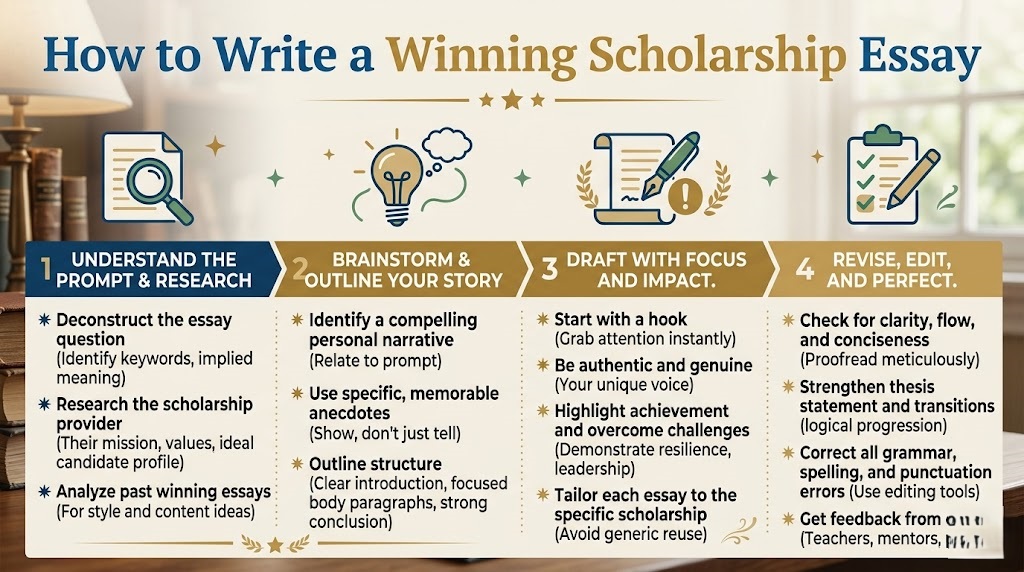
For the essay writing process specific to the programs listed above, our guide on how to write a winning scholarship essay covers the seven structural templates that work across all of these programs. And for the complete verified list of all fully funded scholarships currently open in 2026, see our full breakdown at fully funded scholarships 2026.
Strong Options Without Leaving the Continent
Applicants often assume that a funded degree means leaving Africa, and overlook a set of institutions that are well funded, internationally recognised, and considerably less crowded than the European and North American programmes everyone applies to.
The African Institute for Mathematical Sciences runs fully funded structured masters programmes across several centres, including Rwanda, Senegal, Cameroon, South Africa, and Ghana. Tuition, accommodation, meals, and travel are covered, teaching is by an international faculty, and graduates move on to doctoral programmes worldwide at a high rate.
The Pan-African University, an African Union initiative, operates thematic institutes hosted in Kenya, Nigeria, Cameroon, Algeria, and South Africa, covering science and technology, life and earth sciences, governance, water and energy. Scholarships cover tuition, a monthly stipend, health insurance, and research costs, and applications are open to nationals of any AU member state.
African Leadership University in Rwanda and Mauritius offers heavy need-based scholarships alongside an unusual curriculum built around applied work rather than lectures.
The African University of Science and Technology in Abuja, and the Nelson Mandela African Institution of Science and Technology in Arusha, both offer funded postgraduate places in engineering and applied sciences.
Two practical advantages are worth weighing seriously. Studying within the region avoids the visa refusals, currency requirements, and proof-of-funds thresholds that stop a large share of otherwise strong candidates from taking up places abroad. And the research produced at these institutions is frequently closer to the problems you intend to work on, which matters if your plan is to build a career on the continent rather than to leave it.
Documents, Certification, and Getting Them Sent
More African applicants are eliminated on documentation than on merit, and almost all of it is avoidable with enough lead time.
Transcripts. Most programmes require official transcripts sent directly by your university, sealed or through a secure electronic channel. Many African universities take six to twelve weeks and do not respond to email. Start in person at the registry if you can, get the name of a specific person, and follow up weekly. Request several sealed copies at once: you will need one per application, and the second request takes as long as the first.
Certification and notarisation. Where a programme asks for certified copies, the acceptable certifier is specified and varies: a notary public, a commissioner for oaths, the issuing institution, or the relevant embassy. A copy certified by the wrong authority is rejected, so read the instruction rather than assuming.
Apostilles. Countries party to the Hague Apostille Convention can have documents legalised through a single national authority. Several African countries are not party to it, in which case documents need full consular legalisation, which takes longer and costs more. Establish which applies to you before the deadline month.
Translations. Documents in French, Portuguese, Arabic, or Amharic generally need certified translation into the language of instruction. Use a translator the receiving institution will accept; a translation by a friend who speaks the language is not certified, however accurate.
Name consistency. If your name appears differently across your passport, degree certificate, and transcripts (a common result of different naming conventions and transliteration) obtain a sworn affidavit of name equivalence early. This single document resolves a problem that otherwise stalls visa applications months later.
Paying for the Costs That Come Before the Funding
Nearly every fully funded scholarship has a gap between acceptance and the first disbursement, and the costs falling into that gap stop people who have already won.
The typical upfront outlay includes a language test, application fees where they exist, transcript and certification charges, courier costs for documents, a passport if you do not hold one, a visa application fee, medical examinations, and a flight if not covered. Across several applications this reaches several hundred dollars, which is a serious sum in many contexts.
A few ways people manage it. Prioritise ruthlessly: three well-prepared applications to programmes that fit cost less and succeed more often than twelve scattered ones. Use fee waivers where they exist: several testing bodies and universities offer them on request with evidence of need, and they are granted more often than people assume because so few ask.
Ask the programme directly about pre-departure support. Many fully funded scholarships reimburse visa fees, medical checks, and flights, and several will advance them on request for candidates who cannot pay upfront. This is rarely advertised and frequently available.
Some universities and embassies operate small pre-departure grants for admitted students from low-income countries. Your national scholarship board or ministry of education may also run a supplementary fund. Neither is well publicised; both are worth one email.
Finally, never borrow at high interest against an unconfirmed place. Applications fail for reasons outside your control, and informal loans taken against an expected scholarship are a recurring source of serious hardship. Wait for the written award letter before committing money you do not have.
For programme-by-programme detail on what each scholarship covers, see our guides to scholarships that cover living expenses and fully funded scholarships in 2026.