Top Scholarships for International Students in 2026 (No Application Fee)
Scholarship scams are more sophisticated in 2026 than they have ever been. Fake portals that closely mimic official scholarship websites, consultants charging processing fees for programs that are completely free to apply for, acceptance letters sent before official results dates, these are not edge cases. They are a systematic industry targeting the same motivated students that legitimate scholarship programs are trying to reach. The first principle of this guide is the most important one: every scholarship on this list is free to apply for. No application fee. No registration fee. No consultant fee. If any step in any process requires payment before an official award notification, stop immediately.
Why Understanding Program Purpose Changes Everything
Every scholarship exists to accomplish something specific for the organization funding it. Chevening strengthens UK foreign policy by developing future leaders in partner countries who will maintain and deepen relationships with Britain throughout their careers. DAAD advances German academic influence by funding researchers who will collaborate with German institutions and establish lasting intellectual partnerships. The Korean GKS promotes South Korean academic soft power and cultural relationships. Australia Awards develop professionals who will return home and contribute to the bilateral relationship with Australia. These are not marketing slogans. They are the actual selection criteria, and understanding them changes everything about how you approach each application.
An applicant who understands that Chevening is a UK foreign policy tool writes a completely different essay from one who thinks of it as a prestigious international scholarship to add to their resume. The first essay demonstrates a specific, credible plan to use a UK degree to accomplish something concrete that both advances the applicant's genuine goals and strengthens their home country's ties with Britain. The second essay is eloquent and generic and gets rejected at very high rates regardless of credentials. Read the stated mission of every program you are considering. Then ask yourself honestly: does my genuine profile align with what this program is trying to achieve?
The Major Programmes at a Glance
Before comparing details, it helps to see the shape of each programme, because they differ more in purpose than in generosity.
- Chevening (UK), one-year masters only. Selects on leadership and networking ability. Requires two years of work experience and a commitment to return home for two years. Applications open August, close early November.
- DAAD (Germany), masters and doctoral. Selects on academic and professional fit with development relevance for many streams. Deadlines vary by programme, commonly August to October.
- Erasmus Mundus (EU), joint masters across multiple countries. Selects on academic merit and fit with the specific consortium. Deadlines typically October to January, set by each programme.
- Türkiye Bursları (Turkey), undergraduate through doctoral. Broad eligibility, includes a year of Turkish language tuition. Applications usually January to February.
- Stipendium Hungaricum (Hungary): all levels, allocated through bilateral agreements with partner countries. Applications close mid-January.
- GKS (South Korea): undergraduate and graduate, with a year of Korean language study. Embassy track closes around February, university track around March.
- CSC (China), all levels, multiple application channels. Runs roughly January to April.
- MEXT (Japan), research and undergraduate tracks. Embassy recommendation opens around April.
- Commonwealth (UK): masters and doctoral for citizens of Commonwealth countries, with a strong development focus. Nominations run through national agencies, deadlines around December.
- Australia Awards: masters, targeted at specific partner countries with a two-year return requirement. Deadlines vary by country, commonly opening February.
Detailed profiles of each, including what they cover and how to apply, are set out in our guide to fully funded scholarships in 2026. What follows here is how to choose between them.
Which Programme Fits Which Applicant
The single most useful thing an applicant can do is stop asking which scholarship is best and start asking which one is looking for them.
If you work in government or public policy and can demonstrate influence, Chevening and Commonwealth are built for you. Both weight leadership and public benefit far above academic ranking, and a candidate with a middling degree and a genuine record of responsibility routinely beats a stronger student with none.
If you are academically strong with research ambitions, DAAD and Erasmus Mundus reward this directly. Both assess fit with a specific programme or consortium, and a well-argued academic case matters more than leadership narrative.
If your grades are modest but your direction is clear, Türkiye Bursları, Stipendium Hungaricum, and CSC have broader eligibility and higher acceptance rates than the headline European and UK schemes, while still covering tuition, accommodation, and a stipend.
If you are early career with limited work experience, Stipendium Hungaricum, Türkiye Bursları, GKS, and CSC all accept applicants straight from a first degree. Chevening, Commonwealth, and Australia Awards generally do not.
If you intend to build a career in development, Commonwealth and the development-focused DAAD streams align most closely, and both treat the return commitment as central rather than formal.
If language learning appeals rather than deters, GKS, MEXT, CSC, and Türkiye Bursları all include a funded preparatory language year, which is a heavy benefit disguised as a requirement.
Realistic Odds, and What They Mean
Acceptance rates are rarely published clearly, and applicants planning without them tend to apply to too few programmes.
Broadly, the most selective schemes here operate in the low single digits as a percentage of applicants, with Chevening and Erasmus Mundus among the most competitive. The mid-range programmes, including DAAD's larger streams and Commonwealth, sit somewhat higher. The most accessible (Stipendium Hungaricum, Türkiye Bursları, CSC, GKS) reach rates that make a well-prepared application likely to succeed rather than a long shot.
Two things follow. First, apply across the range rather than exclusively at the top. An applicant submitting to Chevening, Erasmus Mundus, and nothing else has built a plan where the most probable outcome is nothing, despite being a strong candidate. Adding two accessible programmes costs relatively little additional work because the core material is shared.
Second, the odds vary enormously by your own country. Several programmes allocate places by nationality or through bilateral agreements, which means the effective competition is against other applicants from your country rather than the global pool. For applicants from countries that submit few applications, the real probability is far better than the headline figure suggests, and worse for those from countries that submit many.
Where a programme publishes country allocations, read them. That number tells you more about your chances than any general statistic.
What Each Programme Covers
"Fully funded" is used loosely, and the gaps between programmes are worth knowing before you commit.
Nearly all of these cover tuition in full. The differences appear in everything else.
Living stipend varies widely in real terms. Chevening's monthly rate is generous in absolute figures and stretched in London. DAAD's stipend is modest and adequate against German living costs. GKS, CSC, and Türkiye Bursları provide stipends that go considerably further against local costs than the headline figures suggest.
Accommodation is provided directly by Türkiye Bursları, Stipendium Hungaricum, and CSC at many host institutions, which removes the single hardest practical problem of arriving in a new country. Chevening, DAAD, and Erasmus Mundus expect you to find your own.
Flights are covered by Chevening, Commonwealth, Türkiye Bursları, GKS, and Australia Awards. DAAD covers travel on most streams. Erasmus Mundus includes a contribution rather than full cost.
Health insurance is included in most but not all, and where it is excluded the cost is €50 to €120 monthly in Europe.
Dependants are the largest gap. Almost none of these programmes fund family members, and several destination countries have restricted dependant visas for taught masters students. Applicants with families should treat this as a decisive factor rather than a detail.
Our guide to scholarships that cover living expenses sets out the monthly figures side by side.
Checking That a Programme Is Real
Scholarship fraud has become more sophisticated, and the schemes on this page are among the most frequently impersonated.
The rule that resolves nearly every case: no legitimate government scholarship asks you to pay to apply, to pay a processing fee, or to pay to receive an award. Genuine programmes are funded by governments and institutions, and any request for money before an official award letter is fraud.
Verify the domain rather than the page. Chevening operates from chevening.org, DAAD from daad.de, Erasmus Mundus through the European Commission's own portal, Türkiye Bursları from turkiyeburslari.gov.tr. Sophisticated fake portals copy the design precisely and differ only in the address bar. Type the official address yourself rather than following a link from a message or an advertisement.
Warning signs worth taking seriously: a domain registered within the past year, a programme guaranteeing acceptance, a request for your bank details as part of an application, an acceptance arriving before the published decision date, pressure to pay quickly to secure a place, and contact from a personal email address rather than an institutional one.
Be cautious with agents. Legitimate education consultants exist, and so do intermediaries charging large fees to submit free applications. No agent has privileged access to any of these programmes, and none can improve your odds. Where you use one, never let them control your application account or receive correspondence on your behalf.
If something has already been paid, stop, keep every record, and report it to your national cybercrime unit and to the real programme, which maintains records of impersonation.
Applying to Several Without Weakening Any
Most successful applicants apply to between four and six programmes in a cycle. Fewer leaves too much to chance; more produces a set of thin applications.
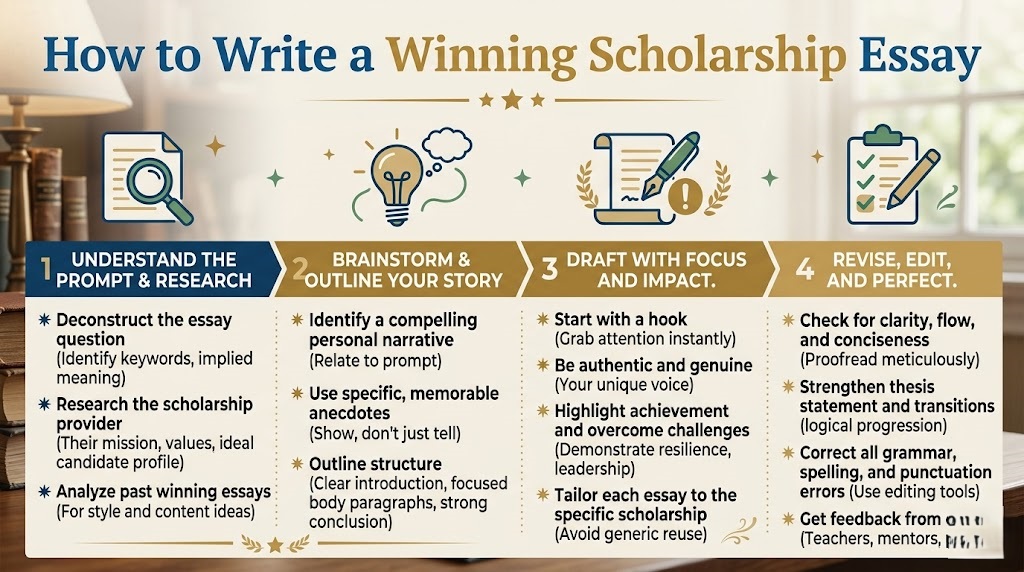
The workable method is one strong core and genuine adaptation. Write a single substantial account of your background, what you have built, what you intend to do, and what capability you currently lack. That core carries across every application. What must change each time is the framing against that programme's stated selection criteria, and the section on what you will do afterwards, which has to speak to what that particular funder exists to achieve.
Referees are the real constraint. Each needs a month's notice, the programme details, and a reminder a week before each deadline. Two referees writing six letters each in December is how referees stop replying, and it is the most common reason strong applications arrive incomplete.
Sequence the deadlines deliberately. Your first submission of a cycle is always your weakest, because the process teaches you what it demands. Where the calendar allows, put a lower-priority application first.
Track everything in one place: programme, deadline, word limits, documents, referee status, submission confirmation. Word limits differ sharply and are enforced automatically, and discovering at midnight that a 1,000-word statement must become 500 produces predictable results.
If You Are Not Selected
Most applicants to these programmes are unsuccessful, including most strong ones, and what happens next matters more than the rejection.
Reapplication is permitted by nearly all of them, and a meaningful proportion of each cohort applied before. What changes the outcome is rarely better writing. It is a stronger record: a year in which you took on something concrete, produced a measurable result, and moved into a role with more responsibility.
Ask for feedback where it is offered. Chevening and several others provide limited feedback to unsuccessful candidates, and it occasionally identifies something you would not have seen.
Reconsider the choice of programme before the choice of essay. A sizeable number of unsuccessful applicants applied to the scheme with the strongest reputation rather than the one whose purpose matched their work. Moving to a programme that is looking for someone like you changes the competition you are in.
Look at the options that are not on any list. University-specific scholarships, departmental funding, national schemes run by your own government, and employer sponsorship are all less competitive than the international programmes and are consistently overlooked. For applicants without extensive experience, our guide to getting a fellowship without a long record covers the programmes designed for exactly that position. If Chevening is on your list, see our dedicated guide to the Chevening Scholarship for 2027 entry, and for the stage that follows a shortlisting, scholarship interview questions and how to answer them.
Country-Specific Routes Worth Checking First
Before applying to any global scheme, check what exists specifically for people from your country. These are consistently the least competitive funding available and the most frequently overlooked.
Bilateral government agreements exist between most countries and their major partners, funding a set number of places each year. India's ICCR scheme, Brazil's CAPES and CNPq programmes, Indonesia's LPDP, Nigeria's PTDF and Bilateral Education Agreement, Kazakhstan's Bolashak, and Mexico's CONACYT all fund citizens to study abroad, frequently with better odds than any international scheme because the applicant pool is limited to one nationality.
Embassy-administered places are the other half of the same arrangement. Many of the programmes discussed above allocate places by country, and the selection happens at the embassy or national commission rather than centrally. For applicants from countries that submit few applications, this changes the odds dramatically.
Diaspora and community foundations fund students from particular regions, ethnic groups, or religious communities, and are advertised almost nowhere. These are found by asking rather than searching.
Employer and professional body sponsorship remains the single most underused route. Ministries, central banks, national utilities, hospitals, and large firms in most countries fund staff study, sometimes with the position held open. Where this exists it resolves both the funding and the post-study employment question at once.
Start with your own ministry of education, your national scholarship board, and the embassies of three countries you would consider studying in. An afternoon of that research turns up options that no international list contains.
A Twelve-Month View of the Cycle
Spreading the work across a year rather than compressing it into deadline season is what separates applicants who submit four strong applications from those who submit one rushed one.
Months one to three. Research programmes and check eligibility honestly against each criterion. Sit any language test now while there is time to resit. Begin or expand a concrete piece of work that will strengthen the record.
Months four to six. Approach referees properly, with a conversation rather than a form. Request official transcripts, which routinely take six to twelve weeks, and order several sealed copies at once. Obtain certified translations where needed.
Months seven to nine. Write the core personal statement with no programme-specific framing. Get it read by three people and revise it twice. Begin university applications where admission must precede the scholarship, as it does for several schemes.
Months ten to twelve. Adapt the core statement to each programme's actual questions and selection criteria. Chase referees a week before each deadline. Check word limits, file formats, and document requirements against each programme's rules. Submit several days early.
The single most common failure across all of these schemes is not weak writing. It is an incomplete application: a referee who did not submit, a transcript that did not arrive, a document in the wrong format. All three are calendar problems rather than merit problems.
After You Are Selected
An award letter is the beginning of a second administrative process, and several applicants lose places at this stage.
Most programmes require you to accept formally within a short window, often two weeks. Missing it can forfeit the award to a reserve candidate.
Student visa applications then run on their own timetable, and consular appointment waits of two to three months are common in high-demand countries. Begin as soon as the award and admission letters exist rather than waiting for every document to be perfect.
Budget for the gap between acceptance and the first payment. Stipends are usually paid monthly in arrears after arrival, which means flights, a rental deposit, and the first several weeks of living costs come out of your own funds. Several programmes will advance or reimburse these on request, and this is rarely advertised. Ask.
Where the award carries a return obligation, read the terms rather than assuming. Some are moral commitments; others are contractual with financial consequences for non-compliance. Understanding which applies before signing is worth the half hour it takes.