How to Write a Cover Letter in 2026: What Hiring Managers Read and What Gets Ignored
Most cover letters are ignored. Not because hiring managers do not read them (surveys consistently show that 77 to 83 percent of hiring managers read cover letters and use them to inform interview decisions) but because most cover letters say the same things. "I am excited about this opportunity." "My skills align with your requirements." "I look forward to hearing from you." A hiring manager who reads fifty applications a week has seen every variation of those sentences and none of them register. The letters that do register are specific, brief, and answer the two questions that matter: why this role, and why you.
What a Cover Letter Is For
A CV lists facts. A cover letter explains context. The CV shows that you have the relevant experience and qualifications. The cover letter explains why you want this particular role at this particular organization, and provides the one or two pieces of evidence that most directly support your candidacy for it. Those are two different jobs, and doing both in one document produces a document that does neither well.
The cover letter is not a summary of your CV. It is not a declaration of enthusiasm. It is not a list of your strengths. It is a concise, specific argument for why you are the right person for this specific role, supported by specific evidence, written in a way that respects the reader's time. Everything in a cover letter should serve that argument or be cut.
Length and Format
The correct length for a cover letter in 2026 is 250 to 400 words, approximately half a page to three quarters of a page. Not one full page. Not two paragraphs. Half a page to three quarters of a page. Research on hiring manager preferences consistently shows that 70 percent of hiring managers prefer cover letters of half a page or less, and that reading time rarely exceeds two minutes. A letter that takes longer than two minutes to read is not a longer argument, it is a less focused one.
Format: same font as your CV, 10 to 12 point size, standard margins, PDF submission unless the application specifically requests a different format. No headers, no bullet points, no graphics. A cover letter is a professional letter. It should look like one.
Structure That Works
Opening paragraph, one to three sentences
The opening paragraph has one job: make the hiring manager want to read the rest. It should not begin with "I am writing to apply for the position of...": that sentence appears in virtually every generic cover letter and communicates nothing. It should not begin with "I have always been passionate about...", this is unprovable and unconvincing.
What works: lead with the specific thing about this role or this organization that makes it the right fit at this point in your career, connected to something concrete. "The product team at [Company] is doing the most technically rigorous work in climate data infrastructure I have seen, and the Data Engineer role maps directly onto the infrastructure migration project I led over the past eighteen months" is a specific, credible, attention-holding opening. It tells the reader immediately that this letter was written for this role, not adapted from a template.
Body paragraph, three to six sentences
The body paragraph is where you provide the two or three most directly relevant pieces of evidence for your candidacy. Not your most impressive accomplishments in general. The accomplishments most relevant to what this role requires. There is a meaningful difference.
Every evidence statement should include a specific outcome, not just a description of activity. "Managed a data pipeline" is an activity. "Built and maintained a data pipeline processing 2.4 million records daily with 99.7 percent uptime over eighteen months" is an outcome. The specific number creates credibility that adjectives cannot. If there is no number, describe the specific outcome: what changed, what was built, what problem was solved.
Do not address perceived weaknesses. Do not open with "Although I don't have direct experience in X...", if you sound uncertain about your qualification, the reader will be too. Present what you bring to the role confidently and let it stand.
Closing, one to two sentences
The closing should be confident and direct, not pleading or overly enthusiastic. "I would welcome the opportunity to discuss how my experience applies to what your team is building. I am available for a conversation at your convenience." Clean, direct, done. Do not thank them for their time in the cover letter, it is a filler phrase that adds nothing.
The Phrases That Kill Cover Letters
These phrases appear in most cover letters and are immediately recognized as signals of a generic application:
- "I am a hard worker", unprovable and expected of every candidate.
- "I am a fast learner", same.
- "I am passionate about your mission", generic and means nothing without specifics.
- "I believe I would be a great fit": your belief is irrelevant; the evidence is what matters.
- "I look forward to the opportunity to discuss my qualifications", everyone says this.
- "Please find attached my CV for your consideration", redundant in a cover letter.
Every one of these phrases should be replaced with something specific. If you cannot replace them with something specific, remove them entirely. A shorter letter without filler is a stronger letter than a longer one padded with standard phrases.
Customization: What It Means in Practice
Customization does not mean changing the company name and the job title in an otherwise identical letter. It means identifying what is specific about this role and this organization (something the company has done, published, built, or stated publicly that connects to your own experience or interests) and making that specific thing visible in your letter.
The test: could this letter be sent to five other companies by changing the company name? If yes, it is not customized enough and will not work. A effective cover letter is so specifically connected to the role and organization that it could not plausibly be repurposed for another application without considerable rewriting. That level of specificity is what creates the impression that you want this job rather than a job.
When to Send a Cover Letter and When Not To
Send a cover letter when the application requests one, when you are applying to a smaller organization or a senior role where it will be read, and when you are making a career change where the connection between your background and the role requires explanation. A well-written cover letter in these contexts materially improves your candidacy.
Skip a cover letter when the application explicitly says it is optional and you are applying to a large organization with a high-volume ATS process where it is unlikely to be read by a human before interview stage, and redirect that time toward further tailoring your CV for the specific role instead. Time spent writing a generic cover letter that will not be read is time that could be spent on something that will improve your application.
The AI Cover Letter Problem in 2026
Surveys of hiring managers in 2026 consistently report that 74 to 80 percent can identify AI-generated cover letters, and that a significant proportion view AI-generated content negatively in a cover letter context, not because AI assistance is inherently wrong, but because the output is recognizably generic and impersonal in ways that directly contradict what a cover letter is supposed to demonstrate. The point of a cover letter is to show specific fit and genuine interest. An AI-generated letter demonstrates neither.
Using AI tools to help structure a draft, check grammar, or identify what to emphasize is reasonable. Submitting an AI-generated letter without serious rewriting and personalization is counterproductive. The 70-30 principle (AI provides structure, you provide 70 percent of the substance and all of the specificity) is a useful framework. The test remains the same: does this letter feel like it was written by a specific person for this specific role, or does it read like output from a system trained on every cover letter ever written?
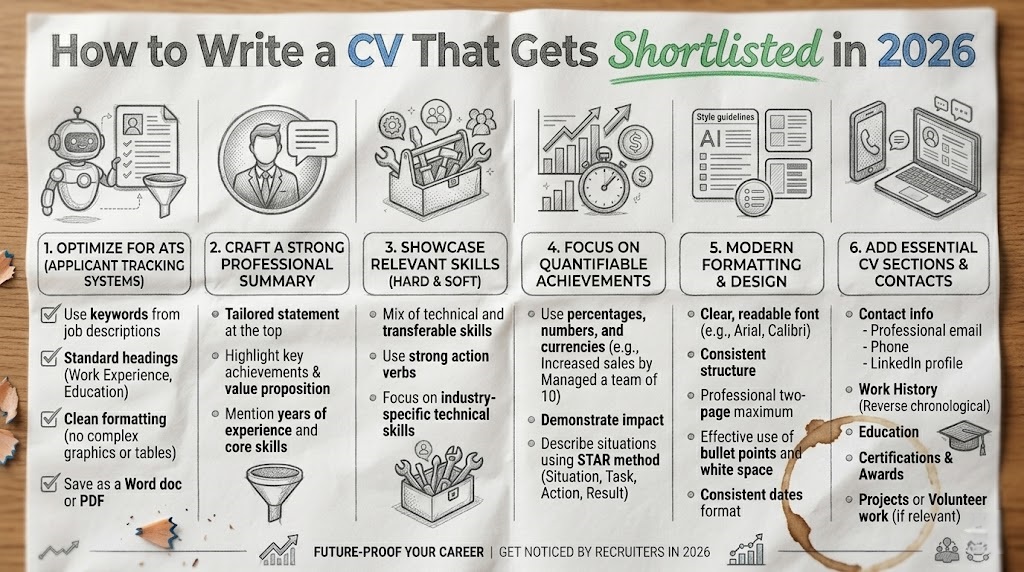
For the CV that your cover letter is supporting, see our guide on how to write a CV that gets shortlisted in 2026. For interview preparation once your application lands you a callback, see job interview questions and answers in 2026.