How to Write a CV That Gets Shortlisted in 2026: Format, Examples, and Common Mistakes
A CV that produces zero responses from dozens of applications almost always has the same set of problems, and they are not the ones most people assume. The issue is rarely the experience itself. It is how that experience is presented: achievements buried inside vague responsibility descriptions, a skills section full of soft keywords that ATS systems ignore, a format that looks professional but communicates nothing specific. A recruiter who reviews CVs professionally can identify the problems within ninety seconds. This guide covers exactly what those problems are and how to fix each one.
ATS Compatibility: The Hidden Filter Most CV Guides Don't Explain
An Applicant Tracking System scans your CV for keywords, parses your work history into structured fields, and scores your application against the job description before a recruiter ever sees it. CVs that use tables, text boxes, headers inside images, columns, or non-standard section names often parse incorrectly or fail to parse at all. The recruiter receives an empty form or garbled text, and your application is disqualified without anyone reading it.
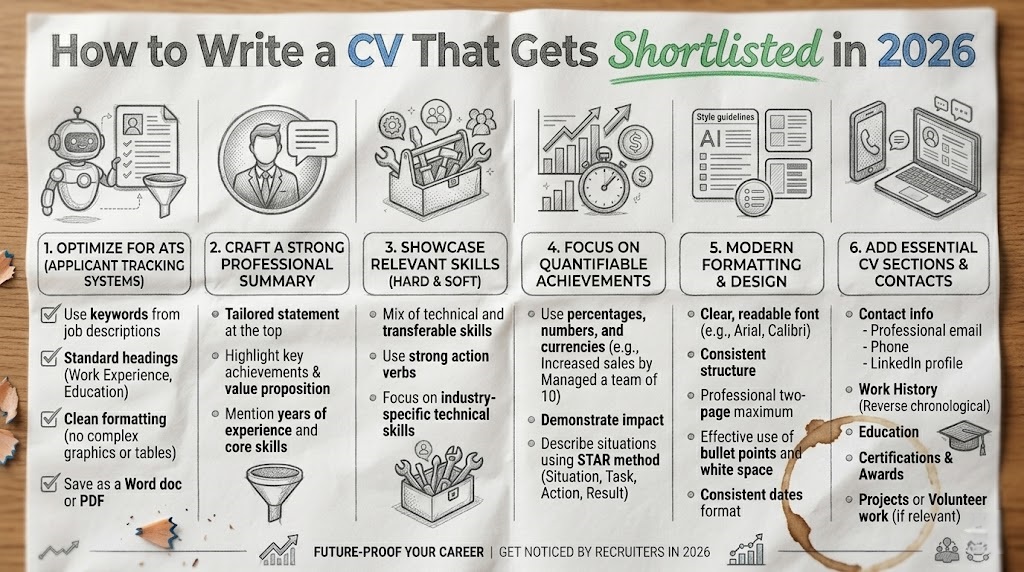
The fix is simple and counterintuitive: a plain, clean CV with standard section headings outperforms a beautifully designed one in the ATS stage every time. Use a single-column layout, standard fonts (Calibri, Arial, or Times New Roman), no text boxes or tables, clearly labeled sections (Work Experience, Education, Skills, not creative alternatives), and save as .docx or PDF with text-selectable characters, not an image-based PDF.
The Format That Works in 2026
A standard professional CV in 2026 follows this structure. Contact information at the top: name, location (city and country, not full address), email, phone, and LinkedIn URL if it's complete. A professional summary of three to four sentences - not an objective statement saying what you want, but a professional summary saying what you offer. Work experience in reverse chronological order, with employer name, job title, dates, and three to five bullet points per role. Education, also reverse chronological. Skills. Optional: certifications, publications, languages.
Length: one page for under five years of experience, two pages for five to fifteen years, never more than two pages unless you're in academia where a CV is different from a resume. The two-page rule matters because recruiters spend an average of six to eight seconds on initial CV review. Every second you make them scroll past relevant information is a second they might give up.
Writing Bullet Points That Work
This is where most CVs lose the hiring manager's attention. The standard CV bullet point reads: "Responsible for managing social media accounts." That is a job description, not evidence of contribution. It tells the reader what you were assigned to do, not what you did or what happened because you did it.
The formula that consistently performs better: Action verb + specific task or project + quantified result. "Grew Instagram following from 8,200 to 41,000 in fourteen months by introducing a weekly video series, increasing website traffic from social by 340%." That bullet point is hiring-manager-readable in three seconds and immediately demonstrates output. If you can't find a number for every bullet, find one for at least half. Numbers create credibility. They're the difference between claiming you "improved processes" and proving you "reduced invoice processing time from 14 days to 3 days by automating the approval workflow."
Keywords: How to Get Past the ATS Filter
Read the job description. Identify the specific skills, tools, and role-relevant terms that appear multiple times or in the requirements section. These are the keywords the ATS is likely scoring for. If you have those skills, use the exact terminology from the job description in your CV - not a synonym, not a slightly different phrasing. If the job says "Salesforce CRM experience," your CV should say "Salesforce CRM," not "customer relationship management software."
Don't keyword-stuff invisible text or paste keywords in white font - modern ATS systems flag this. Just naturally incorporate relevant keywords in your actual bullet points and skills section. The goal is a CV that reads naturally to a human while also being accurately parseable by the ATS.
The Most Common CV Mistakes in 2026
Photograph on a CV: don't include one for applications to the US, UK, Canada, or Australia unless it's requested. In many countries this is standard practice; in English-speaking markets it's unusual and opens you to unconscious bias concerns. Email addresses from school or old domains: use a professional address with your name. Unexplained employment gaps: a two-month gap is invisible; a two-year gap needs a brief, honest explanation in your cover letter. A generic skills section that lists "Microsoft Office" and "good communication skills" - these are expected baseline qualifications, not differentiators. Listing duties instead of achievements - as discussed above. And the biggest one: using the same CV for every application. Tailor the professional summary and the emphasis of your bullet points for each role. It takes twenty minutes and doubles your callback rate.
The One Thing Most CV Guides Miss About 2026
AI-assisted screening is now widespread at companies with more than 50 employees, and the latest generation of these tools goes beyond keyword matching into semantic analysis of your experience narrative. What this means practically: your CV needs to tell a coherent career story, not just list positions. The tools evaluate whether your trajectory makes sense for the role you're applying to. A CV that shows a clear, consistent progression toward the skills and level required for the open position performs considerably better than one with the same qualifications presented in a fragmented or confusing way. Spend time on the sequencing and framing of your experience, not just the content.
CV or Resume: When the Distinction Matters
In the UK, Ireland, most of Europe, and across Africa and South Asia, "CV" is simply the word for the two-page document you send with a job application. In the United States and Canada, "resume" means that document, and "CV" means something else entirely: the long academic record listing every publication, conference paper, grant, and teaching assignment you have accumulated, with no length limit at all.
This matters when you apply across borders. A US employer who asks for a resume and receives an eleven-page academic CV will assume you did not read the posting. A European employer who asks for a CV and receives a one-page American-style resume will usually be fine with it, because the shorter document rarely offends anyone. If you are unsure which convention applies, send two pages maximum and call the file what the posting called it.
One practical note on file naming, which nobody mentions and recruiters notice: name the file Firstname-Lastname-CV.pdf, not cv_final_v4_updated.pdf. Recruiters download dozens of these into one folder. Yours should be findable.
The Professional Summary, and Why Most of Them Are Wasted
The three or four lines at the top of your CV occupy the most valuable space on the page, and most candidates fill them with adjectives. "A dedicated and results-driven professional with a passion for excellence" describes nobody. Every applicant could have written it, which means it distinguishes none of them.
A summary earns its space when it answers three questions in plain language: what you are, what you are good at specifically, and what you are aiming for. Here is the difference in practice.
Weak: "Motivated marketing professional with strong communication skills seeking to leverage my expertise in a dynamic organization."
Better: "Marketing analyst with five years in B2B SaaS, focused on paid acquisition and attribution. Built the reporting stack that cut our cost per qualified lead from $340 to $190 over two years. Looking for a growth role where measurement is taken seriously."
The second version is specific enough to be wrong, which is exactly what makes it credible. It names an industry, a function, a number, and a preference. A hiring manager reading it knows within four seconds whether to keep going.
Rewrite this section for every application. Not the whole CV, just these four lines. It is the single highest-return twenty minutes in the process.
Employment Gaps, Short Stints, and Career Changes
Three situations make people anxious about their CV, and all three are more survivable than applicants assume.
Gaps. Anything under three months does not need explaining, and listing years rather than months on your roles makes most short gaps disappear without misleading anyone. Longer gaps do need a line. Caregiving, illness, study, relocation, redundancy followed by a slow market: write it plainly as a dated entry, one sentence, no apology. "2023–2024: Career break for family caregiving. Completed Google Data Analytics certificate during this period." Recruiters have seen thousands of these. What raises suspicion is the unexplained hole, not the explained one.
Short stints. One eight-month role in an otherwise steady history is noise. Three in a row is a pattern, and you should address it before someone else decides what it means. If the company folded, restructured, or the role was a fixed contract, say so in four words next to the dates: "(contract)", "(company closed)", "(department restructured)". That single parenthesis defuses most of the concern.
Career changes. The mistake here is hiding the old career. You cannot; the dates give it away. Instead, reframe it. A teacher moving into instructional design should not bury six years of classroom work: that is where the curriculum design, stakeholder management, and assessment experience came from. Lead the summary with the destination, let the experience section show the origin, and make the bridge explicit in the bullets. Recruiters do not mind a change of direction. They mind not being able to follow it.
Rebuilding the Skills Section
Most skills sections are a graveyard of words that mean nothing to a filter or a human: communication, teamwork, leadership, problem-solving, Microsoft Office. None of these differentiate you, and none of them are what an ATS is scoring against.
Replace the list with named, checkable things. Software and platforms by exact name. Methodologies you have worked inside. Languages with an honest level attached. Domain knowledge that took time to acquire. Group them so the eye can scan:
- Analytics: SQL (intermediate), Google Analytics 4, Looker Studio, Excel (pivot tables, Power Query)
- Marketing platforms: HubSpot, Google Ads, Meta Ads Manager, Braze
- Languages: English (native), French (B2, professional working)
Two rules keep this section honest. First, if you cannot answer a follow-up question about something for ninety seconds, take it off. Interviewers pick items from this list deliberately. Second, do not claim a level you would not want to be tested on: "fluent" in a language you last used in school is a trap you set for yourself.
CV Conventions Change by Country
The same document does not travel everywhere. A few differences are worth knowing before you apply abroad.
United States and Canada: one to two pages, no photograph, no date of birth, no marital status, no nationality. Including any of these can force a compliance-conscious recruiter to discard the application rather than risk a discrimination claim.
United Kingdom and Ireland: two pages, no photograph. A short "Right to work" line helps if your status is not obvious from your address: recruiters screen for it early and often guess wrong.
Germany, Austria, Switzerland: the Lebenslauf is more formal. A professional photograph is still common, dates are listed month and year, and applications are usually expected to include scanned certificates and references as a single PDF bundle. Leaving these out reads as incomplete rather than concise.
Netherlands and Nordics: two pages, photograph optional and increasingly dropped, direct and unembellished tone. Overselling is noticed and counts against you.
Gulf states: nationality, visa status, and a photograph are commonly expected, and applications without them are sometimes returned for completion.
Japan: many domestic employers still use the standardized rirekisho form rather than a free-format CV. International firms in Tokyo usually accept a Western CV, but a Japanese employer may not.
Scholarship and Academic CVs Are a Different Document
If you are applying for a Masters place, a scholarship, or a research post, do not send your job CV. The reader is asking a different question. An employer wants to know what you can do on Monday. A selection committee wants to know what you are likely to become.
That changes the order. Education moves to the top and carries detail: thesis title, supervisor, grade or classification, relevant coursework. Research output gets its own section, and it should include work that has not been published: conference posters, working papers, an undergraduate dissertation that went somewhere. Teaching, mentoring, and academic service belong here too, because committees read them as evidence of contribution rather than padding.
Length rules relax. A three-page academic CV is normal. Ten pages is normal for someone mid-career. What does not relax is precision: dates, titles, and co-authors need to be exact, because a committee member may well know one of your co-authors.
Funding history deserves its own line even when the amounts are small. A 900-dollar departmental travel grant shows that you have written an application and won it. That signal matters more than the sum.
For the essays that accompany these applications, our guide on writing a scholarship essay covers the structures that selection panels respond to.
Test the CV Before You Send It
Four checks catch most of what goes wrong, and all four take under half an hour.
The paste test. Copy the entire PDF and paste it into a blank text file. What you see is roughly what the parser sees. If your job titles have migrated into the wrong column, if dates have detached from employers, or if whole sections come through as nothing, the layout is fighting the software. Simplify it.
The six-second test. Hand the page to someone who does not work in your field, give them six seconds, take it back, and ask what you do and what level you are. If they cannot say, the top third of the page is not working hard enough.
The evidence test. Go through every bullet and ask what changed because you were there. Bullets that describe assignment rather than outcome either get a number attached or get cut. Half your bullets carrying a figure is a reasonable target; all of them is usually a sign someone invented a few.
The read-aloud test. Awkward phrasing and inflated language are far easier to hear than to see. Anything you would be embarrassed to say out loud to a hiring manager should not be sitting on the page.
References, Portfolios, and the Rest of the Application
The CV rarely travels alone, and the documents around it are where applications quietly fall apart.
References. Stop writing "References available on request." It occupies a line and tells the reader something they already assumed. Use the space for a bullet instead. Keep the actual reference list as a separate file, with each person's name, current title, organisation, relationship to you, email, and phone. Before you send it anywhere, ask each of them. The worst version of this is a recruiter phoning someone who has no idea who you are and cannot remember the project.
Choose referees who supervised your work, not the most senior person who knows your name. A direct manager who can describe what you did on a specific project is worth more than a director who can only confirm you were employed. If you left a job badly and cannot use that manager, a senior colleague or a client is a reasonable substitute, and nobody will interrogate the choice.
Portfolios. For design, writing, development, data, and increasingly marketing roles, the portfolio carries more weight than the CV. Three well-explained pieces beat twenty thumbnails. For each one, say what the problem was, what you did, and what happened afterwards. Work that shows your reasoning is more persuasive than work that only shows the final artefact, because the reasoning is what the employer is buying.
If your work is confidential, describe the shape of it without the client name and the specific figures: "Rebuilt the checkout flow for a mid-sized European retailer; cart abandonment fell by roughly a fifth over the following quarter." No NDA is breached and the substance survives.
The LinkedIn profile. Assume it will be opened within a minute of your CV. If the two disagree on dates, titles, or employers, that discrepancy becomes the first question in the screening call, and it starts the conversation on the back foot. Reconcile them before you apply. Our LinkedIn profile guide covers what recruiters search for and how the profile surfaces in their results.
The cover letter. Some employers ignore it entirely, and you cannot tell which ones from the outside. Where a letter is requested, a weak one does measurable damage, so either write something specific to that organisation or do not send it. The cover letter guide sets out the structure that survives a sceptical reader.
When the CV Is Fine and the Replies Still Do Not Come
At some point it is worth accepting that the document is not the problem. If you have sent sixty applications and heard nothing, the odds are that something upstream of the CV is failing.
The most common cause is the application channel. Public job boards are where the competition is heaviest and where the ratio of applicants to openings is worst. Applications submitted through a referral, or directly to a hiring manager who has reason to recognise your name, convert at several times the rate of cold portal submissions. That is not a comment on fairness; it is just where the numbers are.
The second cause is level mismatch. If you are applying to roles that ask for eight years of experience and you have three, the CV is doing its job correctly by telling the truth. No amount of rewriting fixes a gap that large. Drop a level, get in, and move faster once inside.
The third is geography and work authorisation. Many postings are filtered on right-to-work status before a human sees them. If you need sponsorship, apply where sponsorship exists rather than hoping a general posting will make an exception, our guide to jobs in Europe with visa sponsorship lists the employers and routes that do.
And the fourth, which is harder to hear: the market for your specific function may be contracting. That is worth knowing early, because the response is to add a skill or shift adjacent, not to redesign the same document for the ninth time.
For the conversation that follows a successful application, see our guides to interview questions and answers and salary negotiation.