New Government Scholarships 2026 Just Announced: Deadline Is Closer Than You Think

There is a predictable cycle to how scholarship information spreads online. Someone publishes a roundup in January when the big November and December deadlines have closed. That roundup gets shared thousands of times over the following six months, even though most of the information in it is no longer accurate. By the time most readers find it, the deadlines it references are past, the programs listed as "opening soon" have already opened, and the preparation advice assumes twelve months of lead time when the actual window is three.
This article is written in June 2026 specifically to cover programs that are open or opening imminently, with real current deadlines, real stipend amounts, and honest assessment of which programs move fast enough that reading this next week means missing them entirely.
Why Starting Now Matters More Than Most People Think
Most scholarship applicants dramatically underestimate preparation time. A strong application for Chevening or DAAD takes three to four months of real work. That includes researching which program within the broader umbrella is the right fit for your profile, requesting and receiving certified transcripts from your university, identifying and briefing two to three referees with enough time for them to write quality letters, taking or scheduling any required language tests, drafting a personal statement, getting feedback on it, revising it, and going through a final review before the submission window opens.
The applicants who win the most competitive programs usually started thinking about them six to twelve months before the deadline. They emailed potential supervisors. They attended information sessions. They connected with past recipients and asked real questions about the experience. The essay they eventually submit reflects genuine knowledge of the program, not a hurried attempt to seem like a good fit. That quality of preparation is visible in the writing, and selection panels notice it immediately.
Chevening Scholarships 2027/28 Cohort
Opens: August 6, 2026 | Closes: November 4, 2026 | Window confirmed | Apply at chevening.org
This is the announcement that affects the most applicants globally. The Chevening 2027/28 cycle opens August 6, 2026 and closes November 4, 2026 at 12:00 GMT. Reading this in June026 gives you over two months before the window even opens, and five months before the deadline. That is a genuine preparation window for a program with a three-to-four month preparation requirement. Use it.
The program funds over 1,700 scholars per year from more than 160 nationalities for one-year Masters degrees at UK universities. The monthly stipend is 1,690 pounds inside London and 1,378 pounds elsewhere in the UK. Eligibility requires two years of post-graduation professional work experience, a recognized undergraduate degree, and citizenship in an eligible country. The application essays ask about your networking ability, your leadership history, your career plans, and why you need Chevening specifically to achieve them. Start your preparation at chevening.org.
The single best use of the time between now and August 6 is to draft your four Chevening essays before the portal opens. The essay questions for the 2027/28 cycle will be released with the application, but the underlying questions Chevening always asks remain consistent: what leadership have you demonstrated, what are your networking plans, and what will you do post-degree? You can draft substantive answers to these questions now and refine them when the official prompts are published.
DAAD New Cycles Opening September to November 2026
Opens: September to November 2026 (varies by program) | Masters and PhD | Apply at daad.de
DAAD's main scholarship programs for the 2027/28 academic year open their application windows between September and November 2026. If you are targeting Germany for postgraduate study beginning in 2027, your preparation window is actively open right now. The major programs opening in this cycle include the EPOS scholarship for development-related Masters study, the Helmut Schmidt Programme for public policy professionals, the DeutschlandStipendium for academically outstanding students at German universities, and the standard DAAD Research Grants for PhD and postdoctoral researchers.
The stipend for Masters is confirmed at 992 euros per month, PhD at 1,400 euros per month. All programs include health insurance and a travel allowance. The key document you should be preparing right now is your study or research plan. This is the most important element of a DAAD application and it takes the most time to get right. It needs to be specific about what you want to study, why Germany is the right place to study it, and which German university or research group you are targeting. "Germany has excellent universities" is not a study plan. Full program database at daad.de.
Knight-Hennessy Scholars (Stanford University)
Deadline: October 6, 2026 | Any Stanford graduate program | Full funding | Apply at knight-hennessy.stanford.edu
Knight-Hennessy funds graduate study in any Stanford University program, covering every graduate school and every discipline, with full tuition, living costs of approximately 35,000 to 40,000 dollars per year, and access to one of the most powerful professional networks in the world. The deadline for the next cohort is October 8, 2026. The acceptance rate is approximately 2%, which makes it one of the most competitive programs available.
The Knight-Hennessy application is distinctive in what it evaluates. The program looks for people who are fundamentally curious, collaborative, and purpose-driven rather than purely high-achieving. The application requires three recommendations and a set of essays that focus on your curiosity-driven nature and collaborative tendencies. If your entire narrative is about individual accomplishment, this program is not the right fit. If you can describe a meaningful pattern of working with and through others to pursue questions that excite you, apply here. Apply and read selection criteria at knight-hennessy.stanford.edu.
Erasmus Mundus 2027 Entry Cycle
Opens: October 2026 across multiple consortia | Typical deadlines: January 2027 | Apply through individual program portals
The Erasmus Mundus Joint Masters cycle for September 2027 entry opens consortium by consortium between October 2026 and January 2027. Most deadlines cluster in January 2027. The scholarship covers 1,100 to 1,400 euros per month in living stipend plus full tuition and travel contributions across multiple European countries over a two-year joint degree.
Over 350 programs are available across virtually every academic discipline. The best use of your time right now is browsing the program catalogue at the EACEA Erasmus Mundus catalogue and identifying three to five programs in your field. Read each consortium's specific selection criteria, not just the general Erasmus Mundus overview. These programs are evaluated independently. A competitive application to one Erasmus Mundus program will not automatically be competitive for another program in the same cycle.
Stipendium Hungaricum
Applications open: January 2027 | Full tuition plus free housing | Approximately 25% acceptance rate
Stipendium Hungaricum for the 2027/28 academic year will open in January 2027. The timeline is consistent year to year: January opening, mid-February closing for most country deadlines, with university applications needing to be submitted simultaneously. The program covers full tuition, free university dormitory housing, and a monthly stipend at a lower cash value than Western European programs, offset by Budapest's well lower cost of living.
For countries with large bilateral quotas including Nigeria, Egypt, Indonesia, and Vietnam, acceptance rates are higher than most European equivalent programs. The bilateral quota structure means your competition is primarily other applicants from your country rather than a global pool. Check your country's specific quota and the list of eligible Hungarian universities at stipendiumhungaricum.hu. If you are from a high-quota country, this program deserves to be near the top of your application list.
Commonwealth Scholarships New Round
National deadlines: October to November 2026 | Commonwealth citizens | Full UK funding | Apply through your country NNA
Commonwealth Master's Scholarships for the 2027/28 academic year operate on a national nomination cycle, with most National Nominating Agencies accepting applications between October and November 2026. The scholarship covers full tuition at a UK university, return airfare, living costs, and a thesis grant. Start by finding your NNA at cscuk.fcdo.gov.uk/apply and checking their national deadline. The NNA deadline is usually several weeks before the CSC deadline, so do not wait until November to start preparing.
Commonwealth and Chevening applications can and often should be submitted in the same cycle if your profile fits both programs. The essays are different and the selection criteria differ, but many applicants who are competitive for Chevening are also competitive for Commonwealth. The preparation investment in personal statements, references, and transcripts is largely shared between the two applications.
The Timeline You Should Build Right Now
If you are reading this in June026, here is the realistic preparation timeline for someone targeting 2027 university entry.
June to July 2026: research which programs fit your profile, request certified transcripts from your university (this takes longer than you expect at many institutions), identify two to three referees and have an initial conversation with each about your plans, and begin drafting your core personal statement without program-specific framing.
August to September 2026: refine your essays as Chevening opens on August 6 and DAAD programs begin their September windows, submit your first round of applications, and confirm language test scheduling if needed.
October to November 2026: submit Chevening by November 4, work on DAAD, Commonwealth, and Erasmus Mundus applications in parallel, and start researching Knight-Hennessy if Stanford is a target.
December 2026 to January 2027: finalize and submit Erasmus Mundus and Stipendium Hungaricum applications, all of which have January deadlines.
That is a full application cycle spread over seven months. It is ambitious but it is realistic. Most of the people who miss deadlines or submit weak applications did not have a worse story or weaker qualifications. They had less time and a less organized process. Start now and you are already ahead of the majority.
For the essay writing process itself, our guide on how to write a winning scholarship essay gives you the seven templates and the structural frameworks that work across all of these programs. For the complete list of fully funded options beyond this cycle, see our full breakdown at fully funded scholarships 2026.
Government Scholarships by Region, and When They Open
The programmes that get the most attention are a small fraction of what exists. Sorting by region makes the calendar easier to manage and surfaces schemes that are consistently under-applied.
Europe. Beyond Chevening, DAAD, and Erasmus Mundus, the Swiss Government Excellence Scholarships open in August for the following academic year. The Italian Government MAECI scholarships open in spring. The Vanier and Eiffel programmes in Canada and France both run winter deadlines. The Holland Scholarship and the Orange Knowledge Programme serve Dutch institutions, and the Visegrad Fund covers Central Europe.
Asia. The Korean Government Scholarship runs two tracks with embassy applications typically closing in February and university-track applications in March. Japan's MEXT embassy recommendation opens around April. The Chinese Government Scholarship runs January to April depending on the channel. Taiwan's scholarship programme opens in February, Singapore's SINGA in December, and the Indian ICCR scheme around January.
Middle East. Türkiye Bursları opens in January for around a month, covering tuition, accommodation, stipend, flights, and a year of language study. The King Abdullah University programme and several Gulf institutional schemes run rolling admissions.
Africa. The Mastercard Foundation Scholars Program operates through partner universities with individual deadlines. The African Development Bank's Japan-funded scholarship, the Pan-African University scheme, and the Mo Ibrahim Foundation programmes all have distinct cycles.
Oceania. Australia Awards deadlines vary by country of origin, commonly opening in February. New Zealand's scholarship programme runs a similar pattern.
The practical point is that deadlines are spread across the whole year, which means there is no single application season and no month in which it is too late to start on something.
Programmes That Recently Changed or Expanded
Scholarship terms move between cycles, and applicants working from last year's information make avoidable mistakes.
Several government programmes have expanded their subject priorities toward climate, energy transition, digital infrastructure, public health, and artificial intelligence governance. Applicants whose field sits in one of these areas are competing in a more favourable pool than they were three years ago, and it is worth framing an application to make that alignment explicit where it exists.
Other schemes have narrowed. Some have reduced the number of awards, restricted eligible countries, or tightened the return requirement. A few have moved from covering dependants to excluding them, which materially changes the calculation for applicants with families.
Language requirements have also shifted at the margins, generally in the direction of accepting more test types and Medium of Instruction letters, which has opened several programmes to applicants previously excluded on the test alone.
Three habits protect against working from stale information. Read the current cycle's own call document rather than a summary written elsewhere. Check the eligibility section line by line each year rather than assuming continuity. And where a detail is decisive for you (dependants, age limit, subject eligibility) email the programme and keep the written answer.
Setting Up Alerts So You Do Not Miss an Opening
Most missed scholarships are missed because nobody saw the announcement, not because the applicant was unqualified.
Build a simple monitoring system rather than relying on remembering. Subscribe directly to the newsletters of the programmes themselves, since these are the only sources guaranteed to be accurate and first. Follow the relevant embassies in your country, which announce national scholarship openings on their own channels and frequently host information sessions.
Add your target universities' international office mailing lists, because institution-specific scholarships are announced there and nowhere else, and they are consistently the least competitive awards available.
Set calendar reminders four months before each deadline you care about rather than at the deadline. Four months is roughly the point at which referees, transcripts, and language tests can still be organised without compromise.
Be sceptical of aggregator sites. Many republish outdated deadlines, some invent programmes entirely, and a number exist to collect application fees for scholarships that do not exist. Use them to discover a programme's name, then verify everything on the official site before acting on any detail.
What to Do in the Months Before Applications Open
The period before a cycle opens is more valuable than the weeks after, and most applicants waste it.
Get the documents that take longest. Official transcripts from a university registry routinely take six to twelve weeks. Certified translations take another two or three. Degree certificate replacements, where the original is lost, can take months. None of this can be compressed in December.
Sit any language test now. Results are valid two years, one result serves every application, and having it in hand removes the most common source of last-minute failure.
Have the conversation with your referees. Not a request for a letter, which comes later, but a proper discussion of what you are applying for and why. Referees who understand your plan write specific letters; referees given a form and a deadline write generic ones, and selection panels can tell the difference immediately.
Write the core of your personal statement without any programme-specific framing. Who you are, what you have built, what you are trying to do next, and what currently prevents it. Adapting that core to a particular programme takes a weekend. Producing it from nothing in a deadline week does not work.
Finally, use the time to strengthen the record itself. An applicant who spends six months taking on a concrete responsibility (a project, a role, a measurable result) is a materially stronger candidate than the same person six months earlier, and no amount of careful writing substitutes for that. For the structures that work once you begin drafting, see our guide to writing a winning scholarship essay.
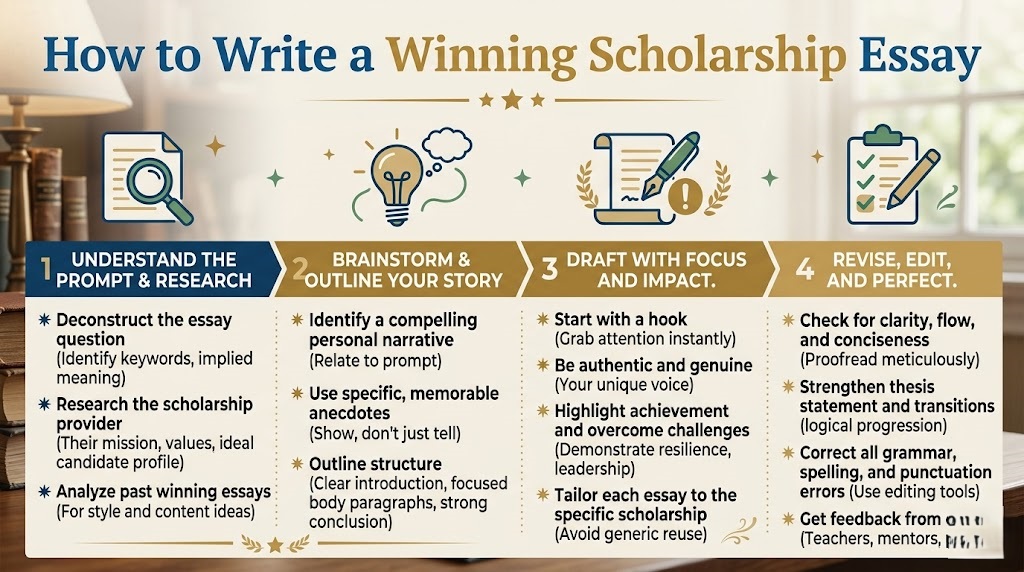
Writing Scholarship Essays That Win
The most consistently useful essay advice: write for the specific selection committee of the specific program, not for a generic audience. Every program has a specific mandate. Chevening wants future UK-connected leaders. DAAD wants researchers who will collaborate with German institutions. The Mastercard Foundation wants talented people who have been structurally blocked from opportunity. Your essay needs to speak to what that committee is selecting for, not to what you think a generic scholarship essay should say.
The structural error that undermines most rejected applications: treating the essay as a list of achievements rather than a coherent narrative about who you are and what you are working toward. Accomplishments provide evidence. They are not the narrative itself. The most compelling fellowship and scholarship essays tell a story that reveals character, motivation, and direction. The achievements appear as evidence for that story, not as the main event.
Practical revision process: read every sentence and ask whether it is doing load-bearing work for your central argument. If not, remove it regardless of how well written it is. The essays that win are the most focused and most specific ones, not the most eloquent ones. Read your final draft aloud before submitting. Every awkward construction and every meandering sentence becomes immediately obvious when you hear it. This takes ten minutes and consistently improves final drafts. For detailed templates covering seven different scholarship types, see our full guide on how to write a winning scholarship essay.