UNESCO and World Bank Fellowships 2026 Now Open: Deadlines, Eligibility, and How to Apply
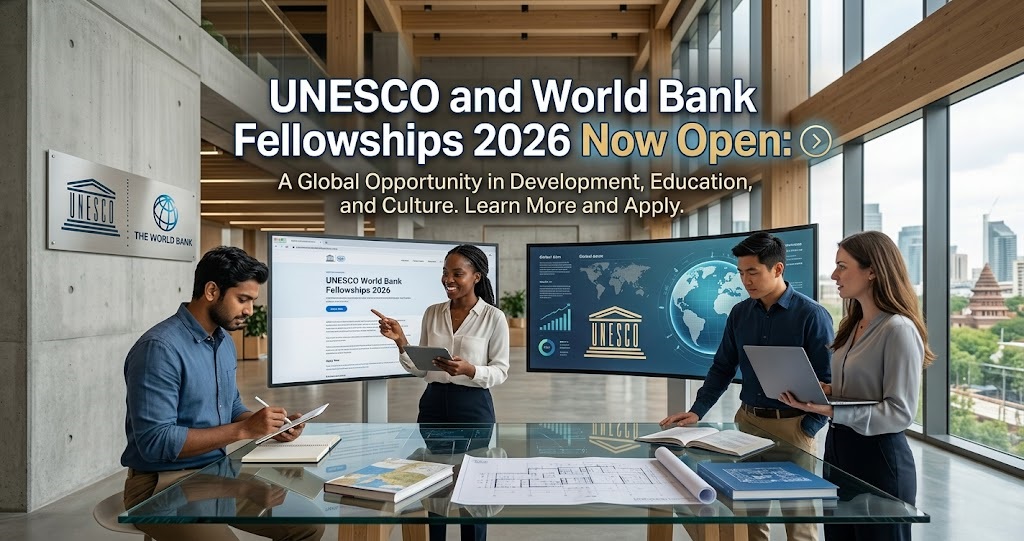
UNESCO and World Bank fellowships sit in a category that confuses a lot of applicants: they're not as widely written about as Chevening or Fulbright, but they're substantive programs worth knowing about in detail. The World Bank's JJ/WBGSP scholarship is one of the best-funded development-sector programs available, and UNESCO's co-sponsored fellowship scheme has produced thousands of alumni who went on to leadership roles in multilateral organizations. Here's what both programs look like in 2026.
Joint Japan/World Bank Graduate Scholarship Program (JJ/WBGSP)
Value: Full funding (tuition + living costs) | Deadline: Typically February
The JJ/WBGSP is co-funded by Japan and the World Bank and provides full scholarships for Masters degree programs in development-related fields at partner universities across the US, Europe, Africa, Oceania, and Japan. The scholarship covers full tuition, a monthly living allowance, health insurance, round-trip travel, and a research grant. Eligibility requirements are stricter than most programs: you must be a national of a World Bank member country (but not high-income), you must already have been admitted to one of the approved degree programs at a partner institution, you must have at least three years of professional development experience, and you must commit to returning to your home country after graduation. The combination of pre-existing university admission and professional experience requirement means this program is most appropriate for mid-career applicants who know exactly what they want to study and where. jjwbgsp.org.
UNESCO's Co-Sponsored Fellowships
Value: Varies by sponsoring institution | Multiple tracks
UNESCO doesn't run a single scholarship program. It runs a co-sponsored fellowship scheme where UNESCO partners with member states, foundations, and universities to offer fellowships to citizens of developing countries. The specific opportunities, eligibility criteria, and funding levels vary by co-sponsor. The UNESCO website maintains a database of current co-sponsored opportunities at unesco.org/en/fellowships. Some of these are fully funded with generous stipends; others are partial grants. Read each opportunity carefully before investing application time. The one pattern worth knowing: UNESCO co-sponsored opportunities tend to favor applicants with clear ties to UNESCO's priority areas - education, science communication, cultural heritage, and media freedom.
World Bank Group Internship Program
Value: Competitive salary | Two rounds per year
The World Bank Group internship program recruits graduate students (Masters or PhD) twice a year: the Summer Program (January–February application, June–August internship) and the Winter Program (September–October application, December–March internship). Interns are paid a competitive salary and work in a specific department on real assignments. Unlike many UN internships, the World Bank internship is paid, structured, and comes with genuine professional mentorship. Eligibility: current enrollment in a Masters or PhD program, returning to school after the internship, and relevant field experience. Apply at worldbank.org internship page.
World Bank Robert S. McNamara Fellowship
Value: $25,000 research grant | For academic researchers
The McNamara Fellowship provides $25,000 to researchers from developing countries to spend three to ten months conducting research at a host academic institution outside their home country. Unlike most World Bank programs, it's designed for people in academic careers rather than the private or NGO sector. Candidates must be nationals of World Bank member countries with a PhD or equivalent. The research must be in a development-relevant field. This is one of the most accessible World Bank programs in terms of competition because it targets a more specific applicant pool than the JJ/WBGSP. Check the McNamara Fellowship page.
How to Position Yourself for Development Sector Fellowships
The World Bank and UNESCO programs share a preference for applicants with clear, specific connections between their professional work and a development challenge. Generic statements about "wanting to contribute to sustainable development" are insufficient. What works is demonstrating that you have a specific professional problem you're trying to solve, that you understand the evidence base around it, and that the knowledge or network this fellowship provides is the specific thing missing from your toolkit. The more specific your gap and the more clearly the fellowship fills it, the stronger your application. This is as true for the JJ/WBGSP as it is for any of the other programs I've covered in this article.
What the JJ/WBGSP Committee Is Weighing
The Joint Japan/World Bank Graduate Scholarship Program is among the most competitive development scholarships available, and its selection logic is narrower than most applicants assume.
The programme exists to build public sector capacity in developing countries. That single sentence explains nearly every selection decision. It is not a general academic scholarship, and applicants presenting themselves primarily as strong students are competing on the wrong ground.
The committee is assessing four things in rough order of weight. Development relevance: whether your professional history and intended study connect to a recognised development challenge in your own country. Commitment to returning: whether your record suggests you will go back and work in that field, rather than remaining abroad. Professional quality: the substance of your work experience, which must be at least three years and in a development-related role. Academic capability: sufficient to complete the degree, treated as a threshold rather than a ranking criterion.
The most common failure is an application from a strong candidate whose work sits in the private sector with no development dimension. A management consultant with excellent credentials and no demonstrable connection to public policy is a weaker applicant here than a mid-level ministry official with an ordinary academic record.
Applicants who already work in government, a public agency, a development organisation, or a civil society body addressing a policy problem should make that centre of the application rather than treating it as background.
The Development Relevance Test
Nearly every unsuccessful application fails on relevance, and the diagnosis is usually visible in a single paragraph.
Relevance is demonstrated by a chain, not a claim. The chain runs: a specific problem in your country, your current work on that problem, the specific capability you lack, the degree that supplies it, and what you will do differently on return. Applications that assert the importance of development while omitting any link in that chain read as generic.
Be concrete about the problem. "Poverty in my country" is not a problem statement. "Smallholder farmers in the northern region lose a third of harvest to post-harvest handling, and the extension service has no data on where the losses occur" is one, and everything downstream of it becomes easier to write.
Be equally concrete about the gap. Committees respond to an applicant who can name what they cannot currently do: build the econometric model, design the survey instrument, evaluate the programme, structure the financing. A statement that you wish to broaden your knowledge does not identify a gap.
Where your work history contains a sector change, explain it rather than hoping it passes unnoticed. A coherent account of why you moved from engineering into water policy is persuasive. An unexplained change looks like drift.
Avoid the overreach that sinks otherwise good applications. A plan to transform a national system reads as unserious. A plan to take one functioning approach and extend it, with named institutions and a realistic sequence, reads as the work of someone who has tried to change something.
Choosing Among the Eligible Universities
The programme funds study only at a defined list of participating institutions, and the choice among them affects both admission and outcome.
The list covers programmes in economic policy, public policy, infrastructure management, health policy, education, environment, and related fields across universities in the United States, Europe, Japan, Africa, and elsewhere. It changes between cycles, so verify the current list rather than relying on an older one.
Three considerations should shape the choice. Programme fit matters most: a development economics programme and a public administration programme lead to different work, and the committee reads your choice as evidence of how clearly you have thought about your plan. Admission probability matters because the scholarship requires unconditional admission, and an applicant admitted nowhere cannot be funded regardless of how strong the scholarship application is. Location affects cost, since the stipend is set against the duty location and a programme in an expensive city leaves less margin.
Apply to several eligible programmes rather than one. The two processes are separate and sequential: university admission first, scholarship consideration after. Candidates who apply to a single programme and are rejected have no route forward that cycle.
The regional programmes hosted at African and Asian universities are consistently under-applied relative to those in the United States and Europe, and for many applicants they offer a shorter distance from the research to the setting where it will be used.
The Return Obligation and What It Means in Practice
These programmes carry an expectation that you will return and work in your home country, and applicants frequently misunderstand how binding it is.
For the JJ/WBGSP, the commitment is to return to your home country or another developing country and work in a development-related field. It is a condition of the award and is taken seriously in selection, where evidence of intention matters as much as the declaration itself.
Practically, the strongest evidence is an employer who is holding your position. A letter from a ministry or agency confirming study leave and a post to return to resolves the question more convincingly than any statement of intent. Where you can obtain one, it is among the most valuable documents in the application.
Where no such employer exists, the alternative is specificity about what you will return to: the organisation you intend to join, the programme you intend to build, the people you have already discussed it with. Committees distinguish between an applicant who has thought about the return and one who has written a paragraph about it.
The obligation is not merely bureaucratic. Programmes funded by donor governments are judged on whether their alumni contribute where intended, and alumni who do not return are tracked. Applicants who intend to emigrate should be honest with themselves about whether this is the right scheme, since there are other funding routes with no such condition.
How UNESCO Fellowships Work
UNESCO's fellowship arrangements operate differently from most scholarship programmes, and the difference confuses applicants who approach them directly.
Most UNESCO fellowships are co-sponsored. A member state or an institution offers places, UNESCO administers the process, and applications are submitted through the National Commission for UNESCO in the applicant's own country rather than to UNESCO headquarters. Applications sent directly to Paris are not considered.
This makes the National Commission the decisive gatekeeper. Each country's commission has its own internal deadline, its own nomination procedure, and frequently its own additional criteria, and these are rarely published widely. The practical first step for any applicant is to find and contact the National Commission in their own country, which is usually located within the ministry of education.
The programmes themselves are typically short: research fellowships, training placements, and specialised courses of a few weeks to a year, in fields aligned with UNESCO's mandate across education, natural sciences, social sciences, culture, and communication. They are not usually full degree funding, which is the most common misunderstanding.
Because nominations are made per country and the number of places per country is small, the competition is national rather than global. For applicants from countries that submit few nominations, the odds are considerably better than the headline programme suggests, and the limiting factor is frequently that few people know the route exists.
UNESCO and World Bank Fellowship Programs
UNESCO fellowships are not applied for directly through a central portal. Nominations go through national government bodies, typically the national education ministry or the national commission for UNESCO in each country. Contact your country's national commission to find out which fellowships it is currently nominating for and what the national nomination process involves. Applications submitted directly to UNESCO without the national nomination process are generally not considered. Find your national commission at unesco.org/en/network-national-commissions.
The World Bank's Joint Japan World Bank Graduate Scholarship funds citizens of World Bank member countries who are development professionals with at least three years of experience to pursue graduate study at designated universities worldwide. The scholarship covers university tuition, monthly stipend, health insurance, and travel. This is among the most geographically detailed development-focused scholarships available and deserves attention from mid-career development practitioners wanting to deepen their knowledge through structured graduate study.
The World Bank Group Internship places approximately 300 interns per year globally. Applications open twice per year for November and May intake. The Robert S. McNamara Fellowship funds postdoctoral research by academics from low and middle income countries at World Bank headquarters. Check all programs at worldbank.org/en/about/careers/programs-and-internships. For the UN career pathway that often complements multilateral fellowship experience, see our complete guide on UN jobs 2026.
What These Fellowships Lead To
Alumni outcomes from these programmes follow recognisable patterns, and knowing them helps you judge whether the fellowship fits your plan.
A large share of JJ/WBGSP alumni return to senior positions in the institutions they came from. Ministry officials come back at a higher grade, central bank economists return with technical capability their institution lacked, and regulators return able to do analysis that previously had to be commissioned. This is the outcome the programme is designed to produce and the one it produces most reliably.
A smaller number move into the international institutions themselves. The scholarship does not confer any hiring advantage at the World Bank, and the programme is explicit about this. What it provides is a credential, a network, and enough understanding of how these institutions think to compete on equal terms. Alumni who join generally do so through the same routes as anyone else (short-term consultancy, the Young Professionals Program, or a specialist post) several years after graduating.
A third group moves into regional bodies, national development banks, or research institutions, which is often where the analytical training is most immediately usable.
The honest caution is that the degree alone does not change a career. Alumni who returned to an institution with no appetite for the skills they acquired describe the experience as frustrating, and the difference between that and a successful return usually lies in whether the employer was involved before departure. Arranging study leave with a named role to return to is worth more than any other post-award preparation.
How These Compare to the Alternatives
For anyone weighing development-sector funding, it helps to see where these programmes sit against the obvious alternatives.
Against Chevening and Commonwealth: those are broader, funding leadership across many fields including private sector and civil society, with no requirement that your work be development-related. They are open to younger applicants with less experience. The JJ/WBGSP is narrower, requires substantive professional experience, and is a better fit for someone already working in public policy who wants technical depth.
Against Fulbright: Fulbright is country-specific, administered through binational commissions, and covers a wider range of disciplines including the arts and humanities. It carries its own two-year home residency requirement. For study in the United States specifically, applicants frequently qualify for both and should apply to both, since the processes are independent.
Against university funding: many of the same institutions offer their own fellowships, assistantships, and need-based aid, and these have no return obligation and no sector restriction. Applicants focused solely on external scholarships routinely overlook funding available from the department they are applying to, which is frequently easier to obtain.
Against employer sponsorship: the most underused route of all. Ministries, central banks, regulators, and large NGOs frequently fund staff study, sometimes in partnership with the same donors. Where it exists, it comes with the returning position already guaranteed, which resolves the single hardest part of the whole exercise.
The sensible approach is to apply to several of these in one cycle rather than treating them as alternatives, since the deadlines rarely clash and the core application material is largely shared. For the wider set of options, see our guides to fully funded fellowships in 2026 and World Bank careers.