Mandela Washington Fellowship 2026: How to Apply, Eligibility, and What You Get
The most instructive data point about the Mandela Washington Fellowship is not the acceptance rate. It is the persistence pattern among people who eventually win it. Public accounts from alumni consistently show candidates who applied three, four, five times before being selected, not because their profiles were weak, but because competitive fellowship selection involves a level of year-to-year variability that rewards persistence as much as qualification. Understanding that pattern changes how you approach this application: not as a single high-stakes attempt, but as a process of iterative improvement over multiple cycles.
What the Mandela Washington Fellowship Offers
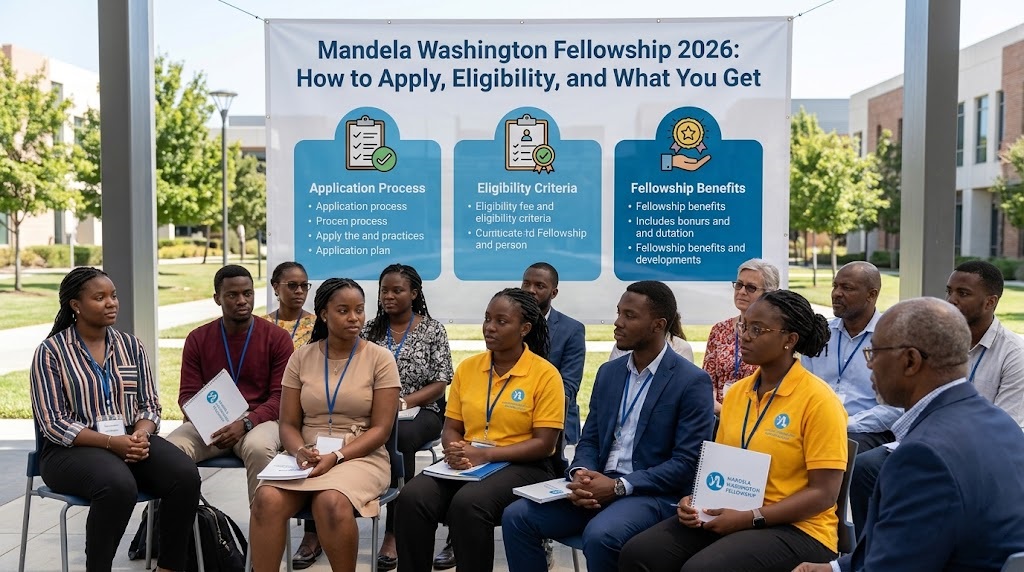
The Mandela Washington Fellowship for Young African Leaders is the flagship exchange program of the US Government's Young African Leaders Initiative (YALI). It brings up to 700 young Sub-Saharan African leaders to the United States each year for six weeks. Fellows are placed at US universities across the country for an intensive Leadership Institute focused on one of three tracks: Business and Entrepreneurship, Civic Leadership, or Public Management. After the institute, fellows participate in a summit in Washington DC and professional development programming. All costs are covered: round-trip flights, accommodation, meals, health insurance, and program fees.
Eligibility - The Details That Trip People Up
The eligibility requirements are specific. You must be a citizen and resident of a Sub-Saharan African country. You must be between 25 and 35 years old at the time of application. You must have demonstrated leadership in your community, organization, or field - this is a requirement, not a preference. You must have limited or no prior experience studying or working in the US for an extended period. And you must be committed to returning to your country after the fellowship.
The age range is a hard cutoff. If you're 24 or 36 at the time the application opens, you're ineligible, full stop. The US experience restriction is worth checking carefully - short tourist visits are fine, but previous academic or professional placements of six months or more in the US generally make you ineligible. Most people understand this, but I've seen applications rejected because someone forgot to disclose a semester-abroad program they did ten years earlier.
The Three Tracks and Which One to Choose
Business and Entrepreneurship is for applicants leading or building organizations with commercial or social enterprise elements. Civic Leadership is for civil society leaders, NGO workers, community organizers, and advocacy practitioners. Public Management is for government employees, policy professionals, and those working in public sector institutions. The most common mistake is choosing the track that sounds most prestigious or where you think competition is lower. Choose the track that most accurately describes your actual work. The selection panel places you at a university program that matches your track, and your essays are evaluated against the specific competencies each track is looking for. A civic leader who applies for the business track because it "sounds better" will write muddled essays and rank lower than applicants whose actual experience matches the track they chose.
How to Write a Strong Application
The Mandela Washington Fellowship application includes several essays and asks about your leadership experiences. The key advice I keep hearing from alumni: be specific and use real examples. Don't describe your general vision for Africa's future. Describe something specific you did, the challenge you faced doing it, and the impact it had. The STAR method (Situation, Task, Action, Result) works well here. "I organized a community forum that led to a policy change" is weaker than "I organized four community forums over six months in three local government areas, generating 1,200 signatures for a petition that led to the reversal of a water-access fee affecting 40,000 households." Both could be true. The second one is believable and specific.
The fellowship application also asks about your plans after the program. Be concrete. Not "I want to contribute to my country's development" - that's the least specific thing you can say. What are you going back to? What specific thing will you do differently or better after six weeks in the US? The best answers describe a concrete action or initiative that has a realistic timeline and is connected to the work you've already been doing.
Timeline for the 2026/27 Cycle
Applications for the next Mandela Washington Fellowship cycle typically open in September and close in mid-November. The fellowship takes place the following summer (June to August for most cohorts). Shortlisted candidates are invited to interviews between February and April of the following year. If you're reading this in mid-2026, start preparing your application materials now - the essays require genuine reflection and multiple drafts, not a rushed weekend effort. Follow the official application portal at mandelawashingtonfellowship.org for exact dates.
What Fellows Get Out of It, Beyond the Resume Line
The honest answer from most fellows I've spoken with: the network is the most durable benefit. The cohort of 700 fellows per year, now compounded over a decade-plus of the program's existence, is a Pan-African professional network that creates real career and project opportunities. Multiple fellows have told me about business partnerships, co-authorships, funding collaborations, and job referrals that came through Mandela Washington connections years after the fellowship itself. The six weeks of programming is useful - but the alumni network is what justifies applying multiple times if necessary.
Writing a Return Plan That Reads as Real
Almost every government-funded fellowship and scholarship asks what you will do when you go home, and almost every applicant answers it badly. The question is not a formality. For programmes funded by a foreign ministry, the return plan is the whole justification for the expenditure, and committees read it more carefully than the personal statement.
The failing version is always the same shape: broad ambitions, no named actors, no sequence. "I will use the skills gained to contribute to the development of my country's health sector and inspire the next generation of leaders." Nothing in that sentence can be checked, and the committee has read four hundred versions of it.
A plan that reads as real has four properties. It is specific about the first step, not the ten-year vision but what happens in month one, with a named organisation, a named role, or a named project. It is connected to something already in motion, because a plan that depends on starting from nothing after you return is a plan the committee cannot assess. It names the obstacle, which is counterintuitive and persuasive: an applicant who says the main constraint is that district health officers have no budget line for this and explains how they intend to work around it sounds like someone who has thought about it. And it is proportionate, because a plan to reform a national system reads as naive, while a plan to take one working pilot from two districts to eight reads as achievable.
Where you already have an employer, a cooperative, an NGO, or a business to return to, say so plainly and name it. Committees weight continuity heavily. Where you do not, describe the specific gap you have identified and the people you have already spoken to about it. The evidence that you have had those conversations is what separates a plan from an intention.
What the Six Weeks Look Like
The academic institute is the core of the fellowship and is frequently misunderstood as a conference. It is closer to an intensive short course with a heavy schedule.
Fellows are placed in a cohort of roughly twenty-five at a host university, and the six weeks run at a pace most participants describe as relentless. Mornings are typically seminars and case work in your track area. Afternoons involve site visits to businesses, civic organisations, or government offices, depending on the track. Evenings frequently carry cultural programming or cohort sessions. Weekends are rarely free.
Teaching style catches people out. American graduate seminars run on participation, and grades or evaluations are less important than whether you contribute. Fellows from education systems where interrupting a lecturer is inappropriate sometimes spend the first two weeks silent and later regret it. Speak early, even imperfectly.
The cohort itself is the part alumni consistently identify as most valuable. Twenty-five people from across the continent, working on comparable problems in different regulatory and market conditions, living together for six weeks. Conversations at dinner produce more durable collaborations than the formal curriculum does.
The summit in Washington follows the institute and brings all fellows together for several days of plenaries, networking, and, for some, meetings with US officials and organisations. Come with a clear, short description of what you do and what you are looking for, because the summit rewards people who can state both in a sentence.
The Professional Development Experience
A limited number of fellows are selected for an additional placement with an American organisation after the institute. It is competitive, it is not guaranteed, and applicants consistently misunderstand how it is allocated.
Selection happens after arrival, based on fit between a fellow's stated goals and the host organisations that have signed up in a given year. Fellows who articulate a precise professional objective are matched more easily than those who describe general interests, for the simple reason that the matching team is looking for an organisation where you would be useful.
Placements typically run four to six weeks and sit in a business, non-profit, or public agency related to your track. The work is genuine rather than observational at good placements, and observational at weaker ones. Fellows who arrive with a specific question they want answered tend to get more out of it than those who arrive to absorb whatever is offered.
If you want to be considered, make your objective explicit in the original application and repeat it in the first week of the institute. The staff coordinating placements read what fellows have written, and a vague objective is harder to place than a narrow one.
Not receiving a placement is common and is not a judgement on your performance. The number of host organisations in any given year is the binding constraint.
Visas, Travel, and the Administrative Reality
The fellowship handles most logistics, which leads some fellows to under-prepare for the parts that remain theirs.
Participants travel on a J-1 exchange visitor visa arranged through the programme. The two-year home residency requirement attaches to this category, meaning that after the fellowship you are expected to return to your country for two years before becoming eligible for certain US immigration categories. For a programme built entirely around returning home this is consistent rather than surprising, but fellows planning to pursue US graduate study immediately afterwards should understand the constraint before making plans.
Travel, accommodation, meals, and a modest incidental allowance are covered. Health coverage is provided for the duration, with the usual limitations on pre-existing conditions, so declare anything relevant early rather than discovering an exclusion in Ohio.
Passport validity is the most common administrative failure. Ensure at least six months beyond the intended return date, and start a renewal immediately if you are anywhere close, because passport processing in several countries takes months.
Practical points fellows mention repeatedly: American summers vary enormously by host city and the buildings are aggressively air-conditioned, so pack for both. Mobile data is expensive without a local SIM. And a supply of small gifts representing your country is useful, because exchange of this kind happens constantly and arriving empty-handed is awkward.
Alumni Funding and the Reciprocal Exchange
The fellowship continues after the six weeks for alumni who stay engaged, and the continuing support is large enough to justify the effort.
Alumni have access to grant competitions for collaborative projects, typically requiring applicants from more than one country, which is why the cohort relationships matter practically and not only sentimentally. Amounts are modest by international standards and meaningful at the scale most alumni operate.
The reciprocal exchange component brings American professionals to work with alumni organisations in Africa, and alumni who have a clear project and the capacity to host tend to be selected. This is one of the more valuable and least publicised elements.
Regional alumni chapters run events, working groups, and in several countries have become sizeable networks in their own right. Involvement is voluntary and self-selecting, and the people who show up are the ones who hear about opportunities first.
The pattern across the programme is consistent: the formal benefits are finite and the network compounds. Alumni who treat the closing ceremony as the end receive a line on their CV. Alumni who spend an hour a month on the network for the following three years receive something considerably larger.
Reapplying After a Rejection
The programme receives tens of thousands of applications for a few hundred places, which means most strong candidates are rejected. Reapplication is permitted and a meaningful proportion of each cohort applied before.
The mistake is resubmitting the same application with minor edits. If the previous version was not selected, the assumption should be that it did not demonstrate enough, and the intervening year is the opportunity to change that.
What improves the odds is a stronger record rather than stronger prose. Take on something concrete: expand the project, take a formal leadership role, produce a result you can quantify. An applicant whose organisation grew from four people to eleven, or whose programme reached a measurable number of people, has a different application regardless of how the essays are written.
Review the track choice as well. A significant number of unsuccessful applicants applied to the track that sounded most prestigious rather than the one matching their work, and switching to the correct one changes which pool you compete in.
Finally, check the eligibility criteria again each cycle, because age limits and requirements are occasionally adjusted, and an applicant who assumes last year's rules still apply can be disqualified without ever being read. For the regional alternative that runs on a different cycle and selects a much larger number of participants, see our guide to the YALI Regional Leadership Centers.
Preparing the Application Over Twelve Months
Applications open in roughly September and close in October, which means the work that decides the outcome happens in the preceding year rather than in the three weeks before the deadline.
The first six months should go into the record itself. Selection favours applicants who are visibly leading something, and the gap between a candidate running a project and one describing an intention is the largest single differentiator. Take on a responsibility you can measure: a programme that reached a number of people, a business that grew by a figure, an organisation that gained members or funding. Committees respond to arithmetic.
Months seven to nine are for documentation and relationships. Collect the evidence of what you have done: records, photographs, letters, anything that turns a claim into a fact. Identify the people who can speak to your work and have a proper conversation with each about what you are applying for.
Month ten is for the first draft, written without looking at anyone else's. The application asks straightforward questions and the temptation to write what sounds impressive is strongest here. Write what is true and specific instead.
Month eleven is for readers. Give the draft to someone who knows your work, someone who does not, and if possible an alumnus of the programme. Ask each what they remember an hour later.
Month twelve is for revision and submission, several days before the deadline rather than on the final evening when the portal is under load.
Applicants who follow roughly this sequence tend to submit once and well. Those who discover the programme in September submit something hurried, and the difference is visible to people who read thousands of these.
For Applicants Outside the Major Cities
A disproportionate share of selected fellows come from capitals and large cities, and applicants elsewhere sometimes read that as the programme not being for them. The pattern has more to do with information and infrastructure than with preference.
Three practical obstacles account for most of it, and each has a workaround.
Awareness. The programme is publicised through channels concentrated in cities: universities, embassies, professional networks. Applicants elsewhere often hear about it after the deadline. Subscribing directly to the programme's own announcements and following your country's US embassy removes this entirely.
Connectivity. The application is online and the interview is frequently by video. Where your connection is unreliable, identify a location with better access in advance and be candid with the interview scheduler about timing. Programme staff arrange around this routinely when asked.
Documentation. Applicants working in informal or community settings sometimes have no formal employer to confirm their role. A letter from a community leader, a cooperative, a local authority, or a client is generally acceptable, and the application does not require a corporate reference.
None of this is a disadvantage in selection itself. Work done with fewer resources is frequently more impressive to a committee than work done inside a well-funded institution, provided the application makes the constraints visible. An applicant who ran a programme across six villages with no budget and no staff has demonstrated something a candidate with an office and a team has not, and the application should say so plainly rather than leaving the reader to infer it.