Top 15 In-Demand Jobs in Europe With Visa Sponsorship in 2026
The phrase "visa sponsorship available" on a European job listing means different things in different countries, for different roles, at different company sizes, and the gap between what it says and what it involves in practice is responsible for enormous amounts of wasted time on both sides of the application process. This guide cuts through that gap. For the main destination countries actively hiring non-EU nationals in 2026, here is what sponsorship involves, which sectors are sponsoring consistently, which roles rarely sponsor despite what the listings suggest, and how to identify the applications worth pursuing from the ones that will not lead anywhere.
The EU Blue Card: The Foundation You Need to Understand
The EU Blue Card is the Europe-wide highly skilled worker permit that allows non-EU nationals to work in most EU member states. As of 2023's revised directive, the EU Blue Card requirements were simplified: a job offer with a salary of at least 1.0 times the average gross annual salary in the host country (down from 1.5x), a recognized higher education qualification or five years of professional experience, and an employment contract of at least six months. Most EU countries have implemented the revised directive, meaning the Blue Card is now more accessible than it was two or three years ago. Germany, the Netherlands, France, and most other major European economies issue EU Blue Cards. Check country-specific thresholds at ec.europa.eu/immigration.
The 15 Occupations With Consistent Visa Sponsorship Across Europe
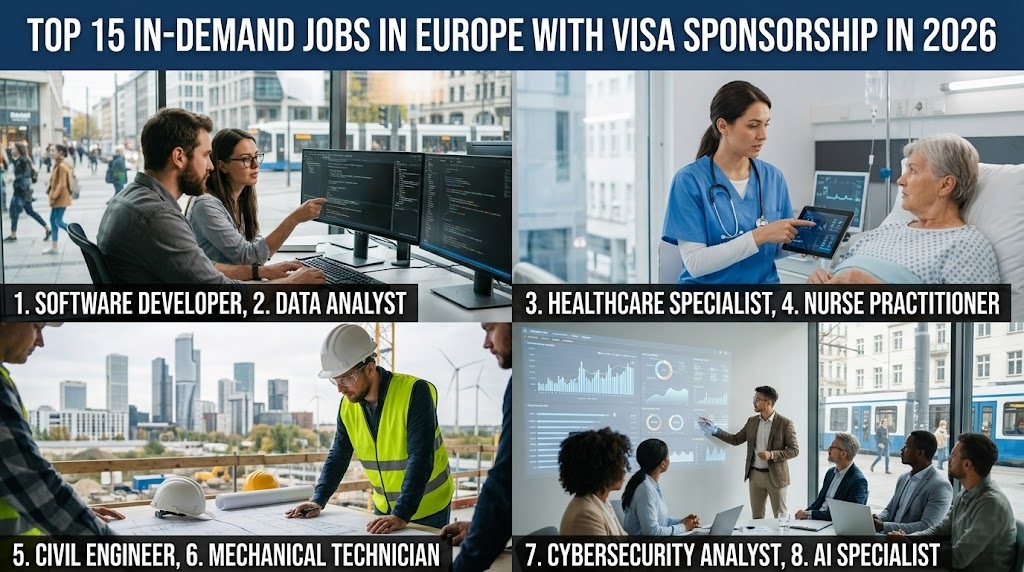
1. Software Engineers and Developers
Salary range: €55,000–€120,000/year. Germany, Netherlands, Poland, Estonia, and Sweden all have active tech hiring pipelines with explicit visa sponsorship. Berlin, Amsterdam, and Warsaw have become major tech hubs with lower cost-of-living than their salary levels suggest. For German tech jobs, check Make it in Germany. Germany's Skilled Immigration Act makes it easier than ever for non-EU tech workers to be sponsored.
2. Registered Nurses and Healthcare Professionals
Salary range: €35,000–€65,000/year. Germany, the UK, the Netherlands, Ireland, and Denmark all face critical nursing shortages and run active recruitment programs for internationally trained nurses. Germany's nursing recognition process takes six to eighteen months but results in a full work permit. The UK runs its own Health and Care Worker Visa which has some of the fastest processing times in Europe.
3. Data Scientists and Machine Learning Engineers
Salary range: €60,000–€130,000/year. Every major European economy is competing for data science talent in 2026. Switzerland, the Netherlands, Germany, and Sweden lead on compensation. Switzerland is outside the EU but has bilateral agreements and its own highly skilled worker permit.
4. Civil and Structural Engineers
Salary range: €45,000–€90,000/year. Infrastructure investment across EU member states under NextGenerationEU funding has created sustained demand for civil engineers. Germany, Austria, Netherlands, and Poland are the most active hiring markets. Professional engineering credentials from many non-EU countries can be recognized through a qualification recognition process - check ANABIN Germany's qualification database for German recognition.
5–15: Other High-Demand Occupations
The remaining most-sponsored occupations in 2026 include: cybersecurity specialists (€60,000–€110,000), cloud and DevOps engineers (€65,000–€120,000), physiotherapists (€35,000–€60,000), secondary school teachers especially in STEM subjects (€35,000–€65,000), logistics and supply chain managers (€45,000–€80,000), accountants and financial analysts (€45,000–€85,000), UX/UI designers (€50,000–€95,000), product managers (€60,000–€110,000), social workers and care workers (€28,000–€50,000), mechanical engineers (€50,000–€90,000), and architects (€40,000–€75,000). All of these occupations appear consistently on national shortage occupation lists in three or more EU member states.
Germany vs Netherlands vs UK: Where to Focus
Germany is the single largest job market in Europe for non-EU workers in 2026. The Skilled Immigration Act (Fachkräfteeinwanderungsgesetz) created one of the most liberal immigration frameworks for qualified workers in Europe. You can now enter Germany to look for a job with a six-month Job Seeker Visa if you have a recognized qualification. The Netherlands has an Expat Center system in major cities that streamlines permits. The UK, post-Brexit, runs a points-based immigration system with a Skilled Worker Visa that requires a job offer from a licensed sponsor - find licensed sponsors at gov.uk.
Where to Find Sponsorship Jobs in Europe
For Germany specifically: Make it in Germany and StepStone. For the Netherlands: Indeed NL and werk.nl. For the UK: the GOV.UK skilled worker visa job search filter on Find a Job UK. LinkedIn filtered by "Sponsorship available" and country is also useful and increasingly reliable as more employers tag their postings correctly.
Germany: The Opportunity Card and What Replaced the Old System
Germany has the largest skilled labour shortage in Europe and has rebuilt its immigration law around that fact. For most non-EU professionals it is now the most accessible large market on the continent.
Three routes matter. The EU Blue Card requires a recognised degree and a job offer above a salary threshold, which for 2026 sits at €50,700 for most occupations and €45,934 for shortage occupations including IT, engineering, medicine, mathematics, and natural sciences. IT specialists can now qualify on three years of demonstrable professional experience without a degree at all, which opened the route to a large group previously excluded.
The Opportunity Card is the new element. It is a points-based job-seeker visa allowing you to enter Germany for up to a year and look for work while there, with permission to work twenty hours a week and take two-week trial employments. Points come from qualifications, language ability in German or English, age, and prior German experience. You need a recognised qualification or a vocational credential, proof you can support yourself, and six points. For anyone who has been applying from abroad without response, being physically present changes the reply rate sharply. Our Germany Opportunity Card guide covers the points table, the proof of funds, and how to switch to a work permit.
The standard skilled worker visa covers those with a recognised qualification and an offer below Blue Card thresholds, including a wide range of vocational trades. Germany recognises vocational training as skilled work in a way most countries do not, which matters for electricians, nurses, mechanics, and chefs.
The obstacle is credential recognition. Your qualification must be assessed as equivalent, through the ANABIN database for degrees or a formal recognition process for vocational training. Start this before applying for anything, because it routinely takes three to six months and every other step depends on it.
German language requirements are lower than people assume for the visa and higher than people assume for daily life. Many technology roles operate in English. Healthcare does not, and generally requires B2.
The Netherlands: A Faster Route With a Narrower Door
The Dutch Highly Skilled Migrant scheme is the most efficient work permit process in Europe, with one significant condition attached.
The condition is that the employer must be a recognised sponsor, registered in advance with the immigration service. There are several thousand, the register is public, and no application is possible with an employer outside it. This narrows your search considerably but also makes it precise: you can work directly from the list rather than guessing.
The requirement is a salary threshold rather than a labour market test. In 2026 the gross monthly figures sit at roughly €5,688 for applicants aged 30 and over, €4,171 for those under 30, and €2,989 for those on a post-study orientation year. There is no degree requirement and no quota. If the salary clears the line and the employer is a sponsor, the permit is close to automatic and frequently issued within two to four weeks.
The 30 percent ruling is the other major attraction: qualifying incoming employees receive up to 30 percent of salary tax-free for a capped period, though the scheme has been progressively tightened and the percentage now tapers over the term. Confirm the current terms with the employer before treating it as part of your compensation.
The orientation year permit deserves attention from recent graduates. Anyone who has completed a Dutch degree, or a masters at a highly ranked university anywhere in the world within the past three years, can apply for a one-year permit to look for work with full labour market access and a reduced salary threshold afterwards.
Housing is the practical difficulty rather than the visa. Availability in Amsterdam, Utrecht, and Rotterdam is severely constrained, and arriving without accommodation arranged is a serious problem.
The United Kingdom After the 2024 and 2025 Changes
The UK remains open to skilled migration and has become markedly more expensive and more restrictive. Anyone working from older guidance will be badly misled.
The Skilled Worker visa requires a job offer from a licensed sponsor, a role at the required skill level, and a salary above both a general threshold and the specific going rate for the occupation. The general threshold was raised sharply and now sits around £38,700 for most applicants, with lower thresholds for new entrants, for those on the immigration salary list, and for certain health and education roles. Roles that comfortably qualified three years ago no longer do.
The care worker route, which accounted for a large share of recent visas, has been restricted, and dependants are no longer permitted on it. The Health and Care Worker visa remains the most accessible route overall, with reduced fees and exemption from the health surcharge, and the NHS is the single largest sponsor in the country.
Cost is the factor people underestimate. A five-year Skilled Worker application can run to several thousand pounds once the visa fee, the Immigration Health Surcharge at £1,035 per person per year, and the certificate of sponsorship are combined. For a family of four this reaches five figures. Some employers cover it; many do not, and asking directly during the offer stage is reasonable and normal.
The Global Talent visa is worth investigating for researchers, academics, and people with a track record in technology or the arts, because it requires no job offer, no sponsor, and no salary threshold. Endorsement is the hurdle rather than employment.
The Graduate visa still allows students to remain for two years after a UK degree with unrestricted work rights, though it has been shortened for some groups and remains under review.
The Routes Most People Overlook
Attention concentrates on three countries, which means the competition concentrates there too. Several other markets are more accessible.
Ireland issues Critical Skills Employment Permits for occupations on a published list, with a salary threshold of €38,000 for listed roles and €64,000 for others. Holders can apply for permanent residence after two years, which is faster than almost anywhere in Europe, and the technology and pharmaceutical sectors sponsor heavily.
Poland has quietly become one of the largest recipients of labour migration in the EU, with a straightforward work permit process, low living costs, and a technology sector paying well above local averages. Language is less of a barrier in international firms than expected.
Portugal offers a job-seeker visa allowing entry for up to 120 days extendable to 180 to look for work, and one of the shorter paths to citizenship in Europe at five years of legal residence. Salaries are low; the residence terms compensate.
The Nordics are underused because people assume the language is prohibitive. Sweden, Denmark, Norway, and Finland all run work permit systems open to non-EU applicants, English is the working language in much of their technology and engineering sectors, and Denmark's positive list covers a broad range of shortage occupations with a simplified route.
Spain has a shortage occupation list and a digital nomad visa that has become a practical route for remote employees of foreign companies, covered in our guide to digital nomad visas.
Identifying Employers Who Do Sponsor
Most wasted application effort goes to companies that were never going to sponsor anyone. Several public sources remove the guesswork.
The UK register of licensed sponsors is published by the Home Office and lists every organisation permitted to sponsor a worker, searchable and updated regularly. If a company is not on it, no UK application is possible, whatever the posting says.
The Dutch recognised sponsor register works identically and is published by the IND.
Germany has no equivalent central list, which makes company size the better proxy: firms that have hired internationally before have the internal process, and firms that have not usually decline rather than learn it.
Beyond the registers, three signals in a job posting are reliable. Explicit mention of visa sponsorship or relocation support means yes. A requirement to hold existing work authorisation means no, and applying anyway is almost always wasted. Silence is ambiguous, and the efficient move is to ask before investing in a tailored application: a short message to the recruiter asking whether the role is open to candidates requiring sponsorship gets an answer within a day and saves hours.
Multinationals, universities, hospitals, and research institutes sponsor far more readily than small and medium-sized firms, for the straightforward reason that they already have the legal infrastructure. Healthcare is the clearest example of this, and our guide to nursing jobs abroad with visa sponsorship covers the licensing routes in detail.
Timelines and What It Costs
Planning against realistic timelines prevents the most common failure, which is a candidate who accepts an offer with a start date they cannot meet.
From accepted offer to arrival: the Netherlands is fastest at roughly two to six weeks. Ireland runs four to ten weeks. The UK takes three to twelve weeks depending on whether priority processing is used and how quickly the sponsor issues the certificate. Germany is slowest, commonly two to six months, largely because of consular appointment availability and credential recognition. Poland and Portugal vary widely by consulate.
Add to every estimate the time to obtain an appointment at your nearest consulate, which in high-demand locations can itself be two or three months and is entirely outside your control. Book it as soon as you have an offer rather than after the paperwork is complete.
On cost, excluding flights and initial accommodation: the Netherlands is modest, with most of the fee borne by the employer. Germany's national visa fee is low but credential recognition, certified translations, and a blocked account where required add up. The UK is by far the most expensive because of the health surcharge. Ireland's employment permit fee is €1,000 for a two-year permit, frequently paid by the employer.
Budget separately for certified translations and apostilles on degrees, birth certificates, and marriage certificates. These are required almost everywhere, take weeks in some countries, and are consistently forgotten.
From Permit to Permanent Residence
A work permit is temporary and tied to an employer. Knowing how long until that stops being true should shape which country you choose.
The EU Blue Card provides the clearest path in Germany, with permanent residence available after 27 months, reduced to 21 months with B1 German. That is unusually fast, and the language incentive is heavy enough to be worth structuring your first two years around.
Ireland allows permanent residence applications after two years on a Critical Skills permit, with citizenship possible after five years of reckonable residence.
The Netherlands requires five years for permanent residence, with a civic integration examination including Dutch at A2.
The UK requires five years of continuous residence for indefinite leave to remain, with strict limits on absences and a requirement to have remained in qualifying employment throughout.
Portugal remains among the shortest routes to citizenship in Europe at five years of legal residence, which is why it attracts people whose priority is a second passport rather than immediate salary.
One structural advantage of the EU Blue Card is mobility: after eighteen months in the issuing country, holders can move to another member state under a simplified process. For anyone uncertain where they want to settle, entering through a country with accessible thresholds and moving later is a legitimate and underused strategy. For roles that travel across all of these markets, see the highest-paying skills in 2026.
Getting Your Qualification Recognised
For a large share of applicants the obstacle is not finding an employer but proving that your qualification means what you say it means.
Two different processes are often confused. Academic recognition establishes that your degree is equivalent to a local one, handled across Europe by the ENIC-NARIC network, with each country operating its own centre. In Germany this runs through the ANABIN database, which lists foreign institutions and qualifications with an equivalence rating, and a qualification absent from it requires individual assessment.
Professional recognition is separate and applies to regulated occupations: medicine, nursing, engineering, law, teaching, architecture, accountancy, and most skilled trades. Here the relevant authority is the national professional body, requirements differ between countries for the same occupation, and the process routinely takes six months to two years.
Start both before you apply for jobs rather than after you receive an offer. Employers in regulated fields cannot hire you without the recognition, and a candidate who has already begun the process is substantially more attractive than one who has not.
Where recognition is partial, the usual outcome is a compensation measure: an aptitude test, an adaptation period under supervision, or additional coursework. This is normal rather than a rejection, and knowing which applies lets you plan realistically instead of assuming the door is closed.
Budget for certified translations and apostilles on every certificate and transcript. These are required almost everywhere, cost per page, and take weeks.
Bringing Family on a Work Permit
Family arrangements differ sharply between these countries and frequently decide which destination is viable.
Germany permits spouses and minor children to join EU Blue Card and skilled worker holders, with spouses generally receiving unrestricted work rights. Blue Card holders are exempt from the German language requirement that otherwise applies to joining spouses, which is a meaningful advantage.
The Netherlands allows partners and children of highly skilled migrants to join, with partners holding free access to the labour market and no separate permit required.
Ireland allows immediate family reunification for Critical Skills permit holders from the outset, and spouses can work without a separate employment permit.
The United Kingdom permits dependants on the Skilled Worker route with full work rights, but the cost is the constraint: each dependant requires their own visa fee and Immigration Health Surcharge for the full permission period, which for a family of four reaches five figures paid upfront.
Two practical points apply across all of them. Minimum income requirements for family reunification exist in several countries and are assessed on your salary alone, so check the threshold before accepting an offer near it. And schooling is generally free in the state system, with international schools charging substantial fees, so establish early whether the local language of instruction is workable for your children's ages.