Research Fellowships for Young African Scholars in 2026: Stipends Up to $30,000
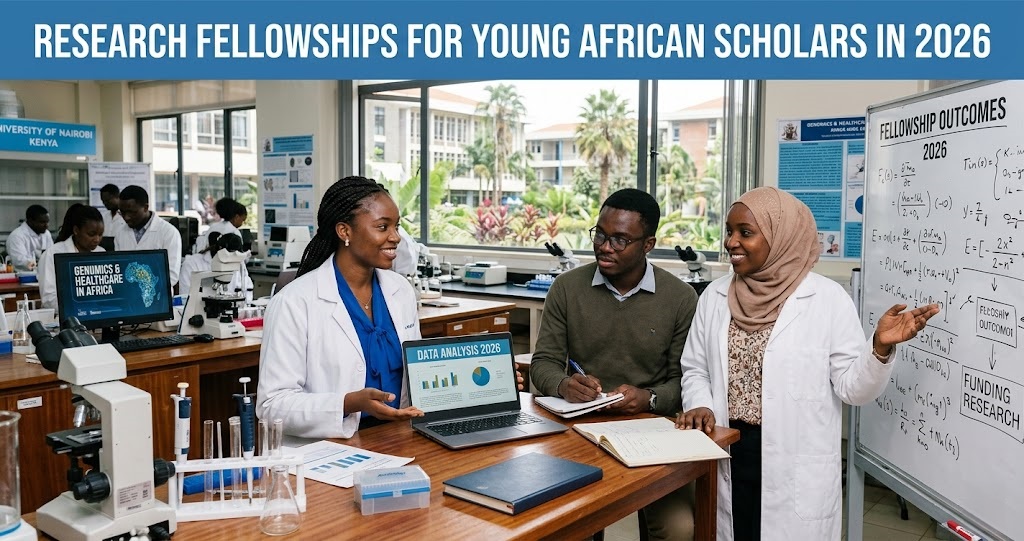
Research funding for African scholars has a structural problem that most fellowship databases do not acknowledge: the most prestigious international research fellowships are designed around institutional partnerships that not all African universities have. A researcher at a major South African or Ghanaian research university has more access pathways than a researcher at a smaller institution in a less-connected country. This guide covers both the well-known options and the ones that are accessible regardless of institutional affiliation, because the gap in awareness, not eligibility, is what keeps most strong candidates from applying.
TWAS Research Grants (The World Academy of Sciences)
Value: Up to $15,000 for research grants | Any African country
TWAS - The World Academy of Sciences - runs several funding programs specifically designed for researchers in the Global South, including a research grants program that provides funding for scientific equipment, research visits, and collaborative projects. The research grants go up to $15,000 and are targeted at researchers at institutions in developing countries where research infrastructure is limited. Critically, you don't need to be at a prestigious institution to apply - TWAS explicitly supports researchers who lack access to research funds through their home institution. The application requires an outline of your research project, a CV, and institutional endorsement. Check twas.org/programmes.
Carnegie African Diaspora Fellowship Program
Value: Full funding for diaspora scholars visiting African universities
The Carnegie African Diaspora Fellowship Program connects African-born scholars working at US and Canadian universities with African host institutions for collaborative research projects of 14 to 90 days. Both the diaspora scholar and the African host institution receive funding. If you're at an African institution looking for external collaboration funding, this is one of the most direct ways to bring in internationally-based expertise and co-author with diaspora researchers. Applications are submitted jointly by both parties. Check IIE's Carnegie program page.
Newton Fund Research Partnerships
Value: Up to £300,000 per partnership | Available in 17 countries including South Africa, Ghana, Nigeria, Kenya
The UK's Newton Fund supports science and innovation partnerships between UK research institutions and partner countries. In Africa, active Newton Fund programs cover South Africa, Ghana, Nigeria, Kenya, Ethiopia, Senegal, and several others. The funding supports joint research projects, researcher mobility, and capacity building. Unlike most individual fellowships, Newton Fund grants go to institutional partnerships - which means your institution needs to have or establish a UK partner. For researchers at institutions that haven't engaged with Newton Fund yet, reaching out to UK universities directly and proposing a partnership is a viable strategy. Check newtonfund.ac.uk for currently open calls.
African Academy of Sciences (AAS) Research Grants
Value: $10,000–$30,000 | African researchers at African institutions
The African Academy of Sciences runs grant programs under its Alliance for Accelerating Excellence in Science in Africa (AESA) platform. The grants fund African researchers at African institutions across a range of health, agricultural, and climate science priorities. The AESA research call structure varies by year and funding priority, but awards consistently range from $10,000–$30,000 for individual investigators and larger for consortium projects. Unlike most international fellowship programs, AAS grants are designed specifically to keep research talent in Africa rather than funding outward mobility. Check aasciences.ac.ke for current calls.
The Wellcome Trust African Programs
The Wellcome Trust funds significant health research in Africa through both individual investigator awards and institutional development grants. The African Institutions Initiative and the Wellcome Trust African Masters in Public Health program are two examples. For health researchers specifically, Wellcome is one of the largest external funders of Africa-based health research in the world. Wellcome African Programmes.
The Thing Most Guides Get Wrong About Research Funding for African Scholars
Most research fellowship guides for African scholars list international mobility programs - programs that fund you to go to Europe or North America. The research ecosystem that will matter most for Africa's next generation of scholars, I'd argue, is the one being built in Africa. Programs like AAS, TWAS, and the Newton Fund partnerships support in-Africa research capacity. They're less glamorous in terms of international prestige, and they pay less in absolute dollar terms than a postdoc in the US. But if you're committed to building research infrastructure and mentoring the next generation of African scientists at African institutions, in-continent funding deserves serious attention alongside the outward-mobility programs.
Finding a Host Institution and a Real Collaborator
Most international research fellowships require a host before you can apply, and securing one is the step that defeats more applicants than the science does.
The approach that fails is a mass email to twenty professors saying you admire their work and would like to join their group. These are recognisable instantly and mostly deleted. The approach that works is narrower and slower.
Identify five researchers whose recent papers connect to what you intend to do. Read two papers by each properly, not the abstracts. Then write to each one individually, in under two hundred words, saying who you are, naming the specific paper and the specific question it raised, describing in two sentences what you propose to do, and stating the funding scheme you intend to apply to with its deadline.
That last element matters more than applicants realise. A host is being asked to commit supervision time, and the request is far easier to evaluate when it comes with a named scheme, a date, and no financial obligation on their part. Many fellowships pay the host institution an overhead, which is worth mentioning explicitly.
Expect most to be ignored and one or two to reply. A reply asking for more detail is not yet a yes, and the correct next step is a short proposal of one or two pages rather than a long one.
Where an existing collaboration exists through a supervisor, a conference, or a previous project, use it. A large proportion of successful applications trace back to a connection that already existed, which is an argument for attending the conferences in your field even when the travel is difficult to fund.
Writing a Proposal That Survives Review
Research proposals are assessed by people reading twenty of them in a weekend, and structure determines whether yours is understood.
The first page decides most outcomes. It needs to establish, in plain language, what question you are asking, why it has not been answered, and why answering it matters. Reviewers who reach the end of page one without knowing the question read the rest sceptically.
Be precise about the gap. "Little research exists on this topic in West Africa" is weak, because it may simply mean nobody needed it. A strong gap statement names what is known, names what is assumed without evidence, and explains what follows from getting it wrong.
Methods sections fail in two directions. Too vague, and reviewers cannot judge feasibility. Too detailed, and the argument disappears into protocol. The workable level is enough that a specialist could assess whether it would work: sample, method, analysis, and the specific reason each was chosen over the obvious alternative.
Include a realistic timeline with milestones, and make it conservative. Proposals promising three years of work in eighteen months signal inexperience more clearly than anything else in the document.
Address feasibility explicitly. Reviewers assessing applications from institutions they do not know are asking whether the work can be done there. State what equipment, data, and support exist, and where something is missing, say how it will be obtained. Silence on this point is read as a problem rather than as an absence of one.
The Budget Section Reviewers Read Closely
Budgets are scrutinised more carefully than applicants expect, and a weak one undermines an otherwise strong proposal.
The two failure modes are opposite and equally damaging. Under-budgeting suggests you do not understand what the work costs, and reviewers conclude the project will stall halfway. Over-budgeting, particularly on equipment and travel, suggests the grant is the objective rather than the research.
Itemise properly. A line reading "fieldwork: $12,000" is not a budget. Break it into transport, accommodation, participant reimbursement, research assistance, and translation, with the unit cost and quantity for each. Reviewers assessing whether a figure is reasonable need to see the arithmetic.
Justify anything unusual in a sentence. A vehicle hire line that looks extravagant becomes reasonable once it explains that the study sites are four hours apart on unpaved roads.
Check what the scheme funds before building the budget around it. Many exclude salary for the principal investigator, cap equipment, refuse to pay institutional overheads, or restrict international travel to conferences where you are presenting. Submitting a budget containing ineligible costs wastes a section of the application and looks careless.
Where co-funding is available from your own institution, even a small contribution, include it. Evidence that the host institution has committed something of its own is read as a signal of institutional support, which is one of the things reviewers are trying to assess and rarely have direct evidence of.
Ethics, Data, and the Permits That Delay Projects
Approvals are the most common cause of delay once funding is secured, and the timelines are long enough to matter at the application stage.
Research involving human participants requires ethics approval from an institutional review board or national ethics committee, and frequently from both your home institution and the host. National committees in several countries meet quarterly, which means a missed submission can cost three months. Where a fellowship runs twelve months, that is a quarter of the project.
Build the approval timeline into the proposal explicitly. Reviewers see a great many applications that assume approval is instantaneous, and one that shows the applicant has accounted for it reads as more credible.
Research permits are a separate requirement in many countries, issued by a national research council or ministry, and are mandatory for foreign-funded work regardless of ethics approval. Fees and processing times vary widely and are rarely advertised clearly.
Data governance has become a substantive part of assessment rather than an annexe. Funders increasingly require a data management plan covering where data will be stored, who controls it, how consent is obtained, how personal information is protected, and whether the data will be shared openly afterwards. Where research involves participants in one country and analysis in another, cross-border transfer rules apply and should be addressed directly.
Material transfer agreements are required for biological samples crossing borders and are frequently the single slowest element of a project. Start them early.
Funders Outside the Familiar List
Competition concentrates on a handful of large schemes, while smaller funders receive a fraction of the applications for grants that are often easier to manage.
Institutional small grants at your own university are the most under-applied funding in existence. Amounts are modest, competition is internal, and a successful small grant produces the track record that larger funders look for.
Learned societies and professional associations in most disciplines run travel grants, fieldwork grants, and early-career awards. They are advertised to members and almost nowhere else.
Embassy and cultural institute schemes fund bilateral research links and are consistently under-subscribed. The relevant embassies in your country publish these on their own sites.
Regional bodies including the African Union, regional economic communities, and continental science organisations run research funds open to nationals of member states with far lower applicant volumes than global schemes.
Disease and thematic foundations attached to specific health conditions, crops, or environmental issues fund narrowly and generously within their remit.
A practical method: identify the last ten papers in your area published by researchers at institutions like yours, and read their funding acknowledgements. That list is a map of funders who have already demonstrated a willingness to support work of your kind in your setting, and it is more useful than any general database.
Research Fellowships for African Scholars
Research fellowships specifically targeting African scholars have expanded appreciably in the past decade. The African Academy of Sciences administers the DELTAS Africa grants for multi-institutional research consortia and individual fellowship streams. The African Union's Pan African University doctoral program supports PhD training across five thematic institutes. TDR at WHO offers competitive grants for disease research by researchers in low and middle income countries. The World Academy of Sciences (TWAS) offers research grants and fellowships for scientists in the global south at host institutions in South Africa, Egypt, Nigeria, Kenya, and other countries.
The Carnegie African Diaspora Fellowship Program funds short-term visits by African-born academics at US and Canadian universities to collaborate with African institutions in Ghana, Nigeria, Kenya, Tanzania, Uganda, Ethiopia, Cameroon, Senegal, and South Africa. The Stellenbosch Institute for Advanced Study (STIAS) offers residential fellowships to researchers at any career stage for concentrated work on specific questions, with fellowship periods from one to ten months.
Strategic advice for researchers based in Africa: pursue every collaborative partnership with international institutions you can access, because these provide resource access and publication opportunities harder to achieve independently from a less-resourced institution. Build genuine expertise in a specific, narrow research question where your geographic and social context gives you access to data or perspectives that researchers elsewhere cannot easily replicate. That contextual advantage, systematically exploited, is the basis of a research career that is additive to global knowledge rather than playing catch-up in areas where better-resourced researchers have greater capacity. For fellowship pathways supporting early career researchers, see fully funded fellowships 2026.
Managing the Grant Once You Have It
Winning funding is the visible achievement. Administering it well is what determines whether you are funded again, and it is rarely taught.
Understand the reporting obligations before the money arrives. Most fellowships require narrative and financial reports at fixed intervals, and late or incomplete reports are recorded. Funders talk to each other, and a reputation for poor reporting follows researchers across schemes.
Keep the financial records from day one rather than reconstructing them. Receipts for every expenditure, a running reconciliation against the approved budget, and a written note explaining any variance. Audits are more common than researchers expect, particularly on grants from public donors, and a missing receipt for a modest amount can hold up a final payment.
Ask permission before reallocating between budget lines. Most funders allow movement up to a threshold without approval and require written consent above it. Spending equipment money on fieldwork without asking is a breach even when the research benefits.
Where the project slips, and most do, tell the funder early. Requests for a no-cost extension are routine and usually granted when made in good time. The same request made three weeks before the end date, after silence, is granted less often and remembered.
Where your institution takes an administrative share, establish at the outset who holds the account, who authorises expenditure, and how long reimbursement takes. Researchers at institutions with slow finance departments frequently end up funding fieldwork from personal accounts for months, which is avoidable if the arrangement is agreed in advance.
Publication, Visibility, and the Grant After This One
The strongest predictor of future funding is what you produced with the funding you had, so the output strategy is part of the fellowship rather than an afterthought.
Plan the publications at the proposal stage. Knowing which papers a project should yield shapes the design and prevents the common outcome of a completed project and an unwritten manuscript. Two solid papers are worth more than a vague intention to write four.
Open access requirements now attach to most major funders, and article processing charges are considerable. Check whether your grant covers them and budget for it if so. Many publishers waive or reduce fees for authors at institutions in lower-income countries, and the waiver is applied on request rather than automatically.
Authorship should be agreed in writing at the start of any collaboration. Disputes over author order between a host institution and a visiting fellow are common, damaging, and almost entirely preventable by a short conversation before the work begins. This matters particularly where the intellectual contribution comes from one side and the resources from the other.
Beyond journals, the visibility that generates future opportunities comes from presenting at conferences, depositing data where the field expects it, and writing a plain-language version of the findings for the people affected by them. Funders increasingly assess this, and it is also how collaborators find you.
Finally, apply for the next thing before this one ends. Funding gaps are the main reason promising early-career researchers leave, and the application you write in month nine of a twelve-month fellowship is the one that prevents one. For related programmes, see our guides to UNESCO and World Bank fellowships and fully funded fellowships in 2026.